
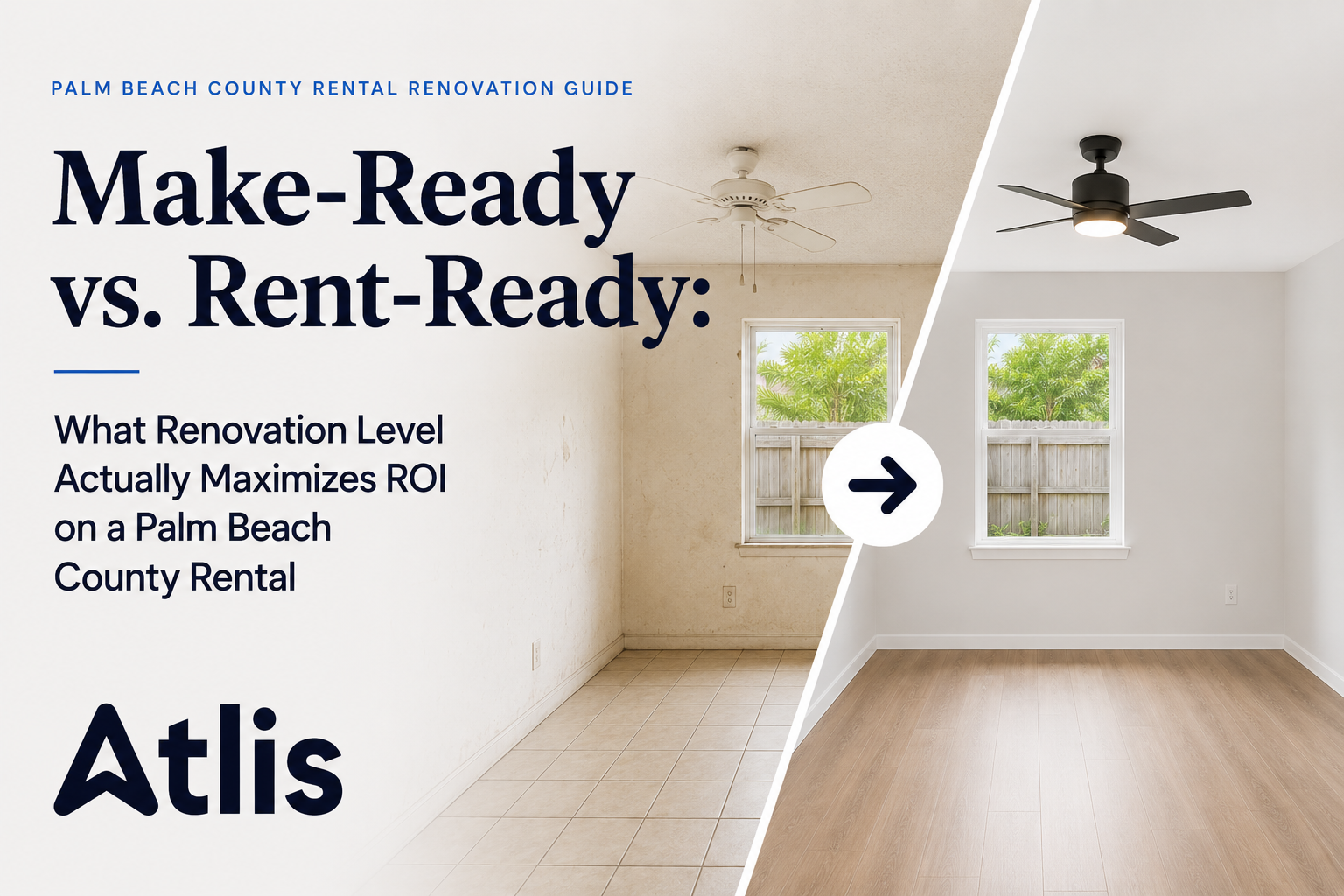
Palm Beach County Rental Renovation Guide · ROI Decision Framework · 2026
Make-Ready vs. Rent-Ready: What Renovation Level Actually Maximizes ROI on a Palm Beach County Rental
Quick Answer
The most expensive renovation mistake Palm Beach County landlords make is choosing the wrong level — over-renovating a property whose market won’t return the investment, or under-renovating one that would have commanded a substantial rent premium. National Cost vs. Value data is clear: minor-scope improvements consistently beat major renovations on ROI. A minor kitchen refresh returns about 85.7% of cost; a major kitchen gut returns 58%. The right renovation level is determined by three variables: the property’s current condition, the rent gap to market, and the target tenant profile. This guide shows how to make that decision correctly.
By Jean Taveras, CEO & Broker-Owner, Atlis Property Management · Updated June 2026
There are three renovation levels for a rental property, and choosing the wrong one is the difference between a smart investment and wasted capital. Make-ready restores the unit to clean, leasable condition. Rent-ready adds strategic improvements to capture a rent premium. Full renovation rebuilds the unit to a substantially higher standard. Most landlords either default to the cheapest option regardless of the opportunity, or over-invest in finishes the market won’t pay for. Both mistakes destroy ROI.
Atlis assesses and manages renovations across Jupiter, Palm Beach Gardens, West Palm Beach, Boca Raton, Delray Beach, Boynton Beach, Wellington, Pompano Beach, Fort Lauderdale, Miami, and the full South Florida service area. The right renovation level is a property-specific calculation — here is the framework we use to make it.
The Three Renovation Levels Defined
| Level | Scope | Typical Cost (PBC) | When It's Right | Goal |
|---|---|---|---|---|
| Make-Ready | Clean, paint, repair, minor fixtures | $1,500–$5,000 | Unit in good condition; minor wear from prior tenant | Restore to leasable; minimize vacancy |
| Rent-Ready | Make-ready + flooring, lighting, fixtures, partial kitchen/bath refresh | $6,000–$18,000 | Dated but sound; meaningful rent gap to market | Capture rent premium; attract better tenant |
| Full Renovation | Comprehensive: kitchen, bath, flooring, systems | $25,000–$70,000+ | Significantly dated; major rent gap; repositioning | Reposition the asset; maximum rent tier |
2026 Palm Beach County estimates. Actual costs vary by unit size, condition, and finish level. Atlis provides property-specific scoping.
The Decision Framework: Three Variables That Determine the Right Level
Variable 1 — Current Condition
The starting point is an honest assessment of the unit’s current condition relative to the competing inventory in its specific submarket. A Palm Beach Gardens unit that is structurally sound with dated-but-functional finishes needs a different intervention than a Riviera Beach unit with worn systems and deferred maintenance. The key question is not “what could we do” but “what is the gap between this unit’s current presentation and the presentation of the units it’s competing against for the same tenant pool.”
Variable 2 — The Rent Gap to Market
The rent gap is the single most important variable in the renovation-level decision. If the unit in its current condition leases for $3,200 and a rent-ready version would lease for $3,700, the $500/month gap ($6,000/year) justifies a meaningful rent-ready investment. If the gap is only $150/month ($1,800/year), a major renovation will never return its cost and a make-ready is the correct call. The renovation level should always be calibrated to the size of the rent gap it can close — never to the renovation an owner wishes the property needed.
Variable 3 — Target Tenant Profile
Different submarkets attract different tenant profiles with different finish expectations. The Wall Street South professional tenant entering Palm Beach Gardens and Jupiter expects modern flooring, updated fixtures, and a contemporary kitchen — and will pay a premium for them. The workforce tenant in a Riviera Beach or Lake Worth Beach Class C unit prioritizes clean, functional, and well-maintained over premium finishes. Matching the renovation level to the target tenant profile’s actual expectations — not over-shooting or under-shooting them — is what maximizes net ROI.
The Data: Why Minor Scope Beats Major Scope
National Cost vs. Value data from the 2025/2026 Remodeling report makes the case directly. Across nearly every interior project category, minor-scope improvements return a far higher percentage of cost than major-scope renovations. A minor kitchen refresh (approximately $26,790 nationally) returns 85.7% of cost; a major upscale kitchen renovation (approximately $79,982) returns just 58%. The same spread holds for bathrooms. The lesson for rental property owners: the goal is not the most impressive renovation — it is the renovation that closes the rent gap at the lowest cost and highest return.
This is why the Atlis approach almost always favors targeted, high-impact, minor-scope improvements over comprehensive gut renovations for rental properties. A strategic rent-ready renovation — new LVP flooring, updated lighting and fixtures, a refreshed (not gutted) kitchen and bath, fresh paint — captures most of the achievable rent premium at a fraction of the cost of a full renovation, producing dramatically better ROI.
⚡ The Over-Renovation Trap in Premium Submarkets
Owners of properties in premium submarkets like Jupiter and Palm Beach Gardens are the most likely to over-renovate — installing $60,000 worth of finishes when a $15,000 strategic rent-ready renovation would have captured nearly the same rent premium. The premium submarket supports a higher rent, but it does not support an unlimited renovation budget. The rent gap still governs the math. Model the achievable rent premium before committing to a renovation level — every time.
How the Atlis 10% Project Coordination Fee Works
Atlis charges a project coordination fee of 10% of the total project cost on any make-ready or renovation over $1,000. The $1,000 is simply the threshold that triggers the fee — projects under $1,000 are still coordinated, with no coordination fee. On a $4,500 make-ready, the fee is 10% of the full $4,500 — a $450 project coordination fee. This covers scope development, vendor sourcing and coordination, timeline coordination, administrative progress check-ins, and a final walkthrough. Combined with Atlis’s below-retail preferred vendor pricing, the net cost to the owner is frequently lower than self-managing the same renovation at retail rates.
Atlis determines the right renovation level for your specific property — then manages it.
Property condition assessment, submarket rent gap analysis, and a renovation-level recommendation that maximizes net ROI. Coordinated at a 10% fee on total project cost for projects over $1,000, with below-retail vendor pricing. FL Broker CQ1071712.
Get a Renovation-Level Assessment →Get a Free Renovation Consultation →Frequently Asked Questions
What is the difference between make-ready and rent-ready for a rental property?
A make-ready restores a unit to clean, functional, leasable condition between tenants. Rent-ready (or renovation-ready) goes further — strategic improvements that increase the achievable rent or attract a better tenant pool, such as new flooring, updated fixtures, or a refreshed kitchen and bath. The right level depends on the property’s current condition, the rent gap to market, and the target tenant profile. Atlis assesses each property individually to recommend the renovation level that maximizes net ROI.
Does renovating a rental property actually increase ROI?
Renovation increases ROI only when the rent premium and reduced vacancy justify the cost. National Cost vs. Value data shows minor-scope improvements consistently outperform major renovations: a minor kitchen refresh returns approximately 85.7% of cost at resale versus 58% for a major kitchen remodel. For rentals, the calculation centers on the monthly rent increase relative to renovation cost — a $1,200 annual rent increase on a $10,000 renovation is a 12% ROI. The highest-ROI rental renovations are typically targeted, minor-scope improvements, not full gut renovations.
How much should I spend on a rental renovation in Palm Beach County?
A common benchmark suggests keeping individual renovation projects under 10-15% of the property’s value, and ensuring the resulting rent supports the investment. The 2% rule of thumb suggests monthly rent should be at least 2% of the all-in property cost for the investment to be worthwhile, though this is difficult to achieve in higher-value Palm Beach County markets. Atlis models the specific rent premium and vacancy reduction for each proposed renovation before recommending a budget.
Does Atlis help decide what renovation level a rental property needs?
Yes. Atlis assesses each property’s current condition, compares it to active competing listings in the specific submarket, identifies the rent gap, and recommends the renovation level that maximizes net ROI — from a basic make-ready to a strategic rent-ready renovation. Atlis then coordinates the project at a 10% fee on total project cost for projects over $1,000, using below-retail preferred vendor pricing. Contact 561.473.3664 for a property-specific assessment.
The Right-Sizing Mistake: Over- and Under-Improving
The two failure modes in renovation-level selection are mirror images of each other, and both destroy ROI. Over-improving means installing finishes the submarket will not pay a premium for — quartz counters and high-end fixtures in a workforce-tier unit where the achievable rent cannot recover the cost. Under-improving means leaving a meaningful rent gap on the table because the unit was merely cleaned when the market would have rewarded a strategic rent-ready refresh. Right-sizing is the discipline of matching the renovation level precisely to the rent gap and the tenant profile — no further.
In premium northern Palm Beach County submarkets — Jupiter, Palm Beach Gardens, Tequesta — the over-improvement trap is most common, because owners assume a high-rent area justifies an unlimited renovation budget. It does not. The rent gap still governs. A unit renting at the top of its range after a $15,000 strategic refresh does not rent meaningfully higher after a $55,000 gut, so the additional $40,000 returns almost nothing. In workforce submarkets like Riviera Beach and Lake Worth Beach, the under-improvement trap is more common — owners do a basic clean when LVP flooring and updated lighting would have captured a real, recurring rent premium.
The Decision in One Question
If you strip the renovation-level decision down to a single question, it is this: what is the monthly rent gap between this unit’s current condition and the condition of the units it competes against, and what does it cost to close that gap? If a $6,000 rent-ready refresh closes a $400/month gap, that is a $4,800/year return on $6,000 — an excellent investment. If a $30,000 renovation closes only a $200/month gap, the math fails. Atlis runs this comparison against live competing listings before recommending a level, so the renovation is calibrated to the gap it can actually close — not to an owner’s hopes or a contractor’s upsell.
Right-Sizing Checklist
- Pull live competing listings — same submarket, bed/bath count, and condition tier
- Identify the monthly rent gap between current condition and competing condition
- Price the renovation that closes that gap — and only that gap
- Confirm the annual rent premium exceeds 15–20% of the renovation cost
- Match finishes to the tenant profile — not to a higher tier the market won’t pay for
How do I know if I’m over-improving my rental?
You are over-improving if the finishes you are installing exceed what comparable rented units in your submarket offer, or if the projected rent premium cannot recover the renovation cost within a reasonable period. A useful test: if the annual rent increase is less than 15–20% of the renovation cost, the project is likely over-scoped for that submarket. Atlis compares your property against live competing listings to right-size the scope before any work begins.
About the Author
Jean Taveras — CEO & Broker-Owner, Atlis Property Management LLC
3801 PGA Blvd., Ste. 600, Palm Beach Gardens, FL 33410 · 561.473.3664 · info@atlispm.com
FL Real Estate Broker License CQ1071712 — myfloridalicense.com · BBB Accredited through April 2027
Renovation ROI benchmarks sourced from the 2025/2026 Remodeling Magazine / Zonda Cost vs. Value Report and Buildium’s 2026 State of the Property Management Industry Report. These are national averages; actual ROI varies by local market, property condition, and execution quality. Jean Taveras manages renovation project coordination across Palm Beach County.
For informational purposes only. Renovation ROI figures cited are national benchmarks from the sources listed and will vary by local market, property condition, and execution. Not financial advice. Consult Atlis for a property-specific renovation analysis.
Choose the Right Renovation Level for Your Palm Beach County Rental
Atlis assesses your property’s condition, analyzes the submarket rent gap, and recommends the renovation level that maximizes net ROI — then manages the project end to end.
Get a Renovation-Level Assessment →Get a Free Renovation Consultation →Call — 561.473.3664 →
info@atlispm.com · 3801 PGA Blvd., Ste. 600, Palm Beach Gardens, FL 33410 · FL Broker CQ1071712 · BBB Accredited