
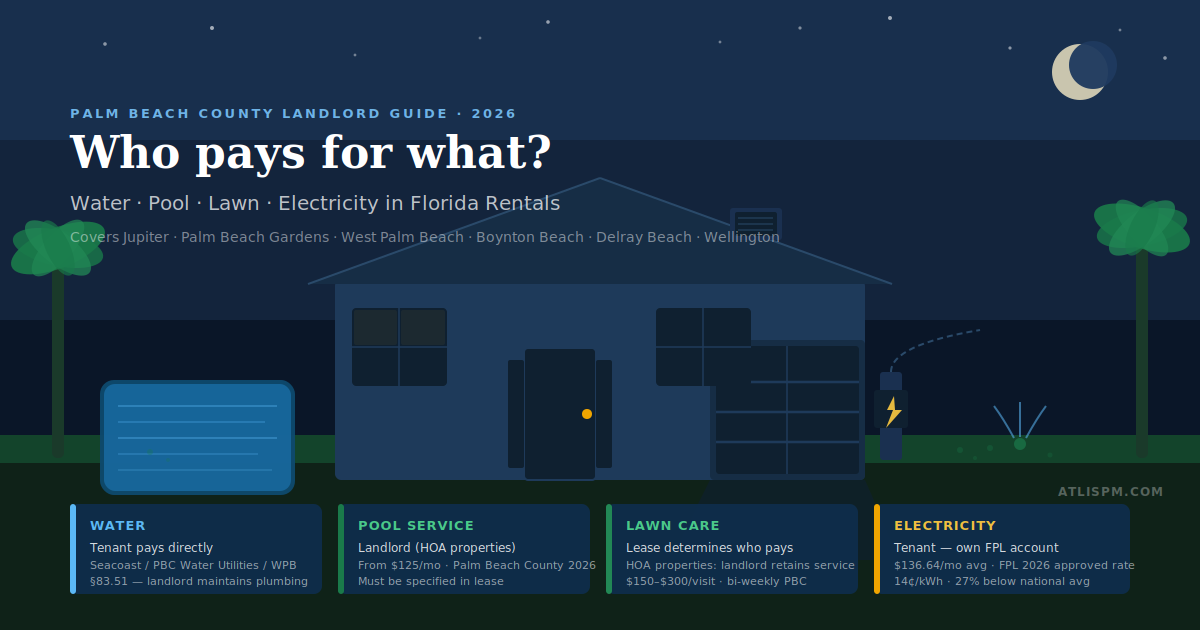
Palm Beach County Landlord Guide · Utility Responsibility · 2026
Who Pays for What? Water, Lawn, Pool and Electricity in Florida Rentals
Quick Answer
Florida law does not automatically assign utility responsibility to either landlord or tenant — the lease controls everything. In most Palm Beach County single-family rentals, tenants pay electricity and water directly to FPL and the local water utility. Pool service and lawn care depend on the lease, but landlords in HOA communities — PGA National, Abacoa, BallenIsles — almost always retain these to protect against HOA violation fines. The single most common landlord mistake in South Florida is failing to specify these four categories in writing, leaving a gray area that produces disputes, deferred maintenance, and habitability liability.
By Jean Taveras, Broker-Owner, Atlis Property Management · Updated May 2026
Every day in Palm Beach County, landlords and tenants sign leases that don’t clearly assign responsibility for water, electricity, lawn care, and pool service. Three months into the tenancy, the pool turns green, the lawn gets an HOA violation notice, and nobody knows who was supposed to handle it. The phone calls start. The disputes begin. In some cases, the habitability claim follows.
Atlis manages units across Jupiter, Palm Beach Gardens, West Palm Beach, Boynton Beach, Delray Beach, and Wellington. The utility clarity question is one of the most common lease gaps we inherit when taking over self-managed properties. This guide covers every utility category, the Florida statute behind it, the actual 2026 costs in Palm Beach County, and exactly what the lease needs to say.
The Florida Legal Framework: What the Statute Says
Florida Statute §83.51 is the foundation of the landlord’s habitability obligation. It requires landlords to maintain the property in compliance with applicable building, housing, and health codes and to keep plumbing in reasonable working condition. §83.51(1) also contains a specific provision that is frequently misread: “Nothing contained in this subsection prohibits the landlord from providing in the rental agreement that the tenant is obligated to pay costs or charges for garbage removal, water, fuel, or utilities.” This means the default is that the landlord holds the obligation — but the lease can shift that obligation to the tenant. If the lease is silent, the landlord is exposed.
Florida Statute §83.67 is the other critical provision every Palm Beach County landlord needs to understand: it absolutely prohibits landlords from interrupting utility service — water, electricity, or any other utility — as a means of forcing a tenant to pay rent or vacate. Violating §83.67 carries statutory damages of three months’ rent or actual damages, whichever is greater, plus attorney fees. It does not matter that the landlord pays for the utility, that the tenant has not paid rent, or that the landlord believes the tenancy has ended. If the tenant is in possession, the utilities stay on.
⚠ The Utility Shutoff Trap — Florida Statute §83.67
Landlords who pay for utilities and attempt to shut them off to pressure a non-paying tenant are committing an illegal act under Florida law — not just a lease violation, but a statutory violation with automatic three-month-rent damages. The correct path for a non-paying tenant is a Three-Day Notice to Pay or Vacate under §83.56, not a utility shutoff. This applies equally to landlords in Jupiter, West Palm Beach, Boynton Beach, and every other Palm Beach County city.
Electricity in Palm Beach County Rentals: FPL, Rates, and Lease Assignment
Florida Power & Light (FPL) serves virtually all of Palm Beach County — Jupiter, Palm Beach Gardens, West Palm Beach, Boynton Beach, Delray Beach, and Wellington are all FPL service territory. As of January 1, 2026, the Florida Public Service Commission approved FPL’s four-year rate agreement, setting the typical residential monthly bill for a 1,000-kWh customer at $136.64 — a $2.50 increase from the prior rate. EnergySage’s May 2026 data confirms the cost of electricity in Palm Beach County at 14 cents per kilowatt-hour, approximately 27% below the national average. For context, a Palm Beach County 3-bedroom home running central air conditioning through a South Florida summer typically consumes 1,500 to 2,500 kWh per month — producing bills of $200 to $350 in peak season.
For single-family rentals throughout Palm Beach County, the standard and strongly preferred practice is for the tenant to establish their own FPL account and pay electricity directly. This is clean, it keeps the landlord out of the billing relationship, and it means electricity cannot become a collection issue between landlord and tenant. The lease should state explicitly: “Tenant shall be responsible for establishing and maintaining an active FPL service account for the property at tenant’s expense for the duration of the tenancy.” The landlord should obtain confirmation that service has been transferred before move-in.
The scenario to avoid: the landlord’s name remains on the FPL account through the tenancy. If the tenant fails to pay the landlord for electricity included in rent, the landlord cannot shut off the power (§83.67) and cannot deduct the unpaid balance from the security deposit except through the §83.49 claim notice process. Keeping electricity in the tenant’s name eliminates this exposure entirely.
✓ Electricity Best Practice for Palm Beach County Landlords
Require the tenant to transfer FPL service into their name before the lease commencement date. Obtain the tenant's FPL account number for your records. If electricity is being included in rent (rare for SFH), include a specific dollar cap in the lease and a billing-back provision if consumption exceeds the cap.
| Utility | Provider | Typical Monthly Cost | Who Should Pay | Lease Language Required |
|---|---|---|---|---|
| Electricity | Florida Power & Light (FPL) | $136–$350 depending on usage | Tenant directly | Yes — transfer to tenant name before move-in |
| Water/Sewer | PBC Water Utilities, Seacoast, or City | $50–$120 avg residential | Tenant directly (SFH) or landlord (some MF) | Yes — account in tenant name |
| Pool Service | Licensed pool contractor | $125–$200/mo in PBC (2026) | Landlord (HOA) or Tenant (non-HOA) | Yes — specify who, frequency, and chemicals |
| Lawn Care | Licensed landscape company | $150–$300/mo bi-weekly PBC | Landlord (HOA) or Tenant (non-HOA) | Yes — specify scope, frequency, HOA fine responsibility |
| Pest Control | Licensed pest company | $50–$150/quarter | Shared (landlord: structural; tenant: interior hygiene) | Yes — distinguish structural vs. routine |
| Trash | Municipal or HOA | Often included in HOA or rent | Landlord (HOA) or Tenant (non-HOA) | Clarify if not HOA-included |
2026 Palm Beach County rates. Actual costs vary by property size, location, and service provider.
Water in Palm Beach County Rentals: Know Your Local Provider
Palm Beach County’s water utility landscape is fragmented — who provides your water depends on where the property is located, and that affects both account setup and billing. The major providers: Palm Beach County Water Utilities Department serves unincorporated PBC and several municipalities including Boynton Beach, Delray Beach, and portions of Boca Raton; Seacoast Utility Authority serves Jupiter and Palm Beach Gardens; City of West Palm Beach Public Utilities serves West Palm Beach proper; and City of Boca Raton Utility Services serves Boca Raton city limits. Knowing the correct provider before lease execution matters — it affects who the tenant calls to set up service and whether the transfer requires a deposit.
For single-family homes throughout Jupiter, Palm Beach Gardens, and West Palm Beach, the standard practice is for the tenant to establish water service in their own name at move-in. Florida Statute §83.51 requires the landlord to maintain plumbing in reasonable working condition — meaning if a pipe fails, that’s the landlord’s responsibility to repair. But the water bill for the water flowing through that pipe is the tenant’s to pay once assigned by the lease.
The Water Bill Liability Gap — Why This Matters in South Florida
South Florida’s subtropical climate creates a specific water liability risk for landlords: irrigation systems. Most Jupiter, Palm Beach Gardens, and Boynton Beach single-family rentals have automatic irrigation systems that run year-round. If the lease assigns water to the tenant but says nothing about the irrigation system — who programs it, who adjusts it seasonally, who reports a broken head — the tenant may run the system continuously, generating a $400 water bill that creates a dispute about who pays it and whether the irrigation damage is tenant-caused or a maintenance issue. Atlis’s standard lease addendum for Palm Beach County SFH rentals addresses irrigation explicitly: the landlord programs the system at move-in, the tenant is responsible for adjusting seasonally and reporting malfunctions, and any water bill increase attributable to an unreported irrigation malfunction is the tenant’s responsibility after written notice.
“The water bill dispute is one of the most preventable landlord-tenant conflicts in Palm Beach County. A three-sentence irrigation clause in the lease eliminates 90% of it. We add it to every single-family lease we manage.”
— Jean Taveras, Broker-Owner, Atlis Property Management · FL Broker License CQ1071712
Irrigation Clause:
"Landlord shall program the irrigation system at commencement of tenancy. Tenant is responsible for seasonal adjustments, reporting any system malfunctions or broken heads to the property manager within 24 hours of discovery, and any water bill increase attributable to an unreported irrigation malfunction after written notice from Landlord."
Pool Service in Palm Beach County Rentals: The HOA Complication
Pool service responsibility is the most consequential utility decision for Palm Beach County landlords — especially in Jupiter and Palm Beach Gardens where a significant portion of the rental inventory sits in HOA-governed communities. The baseline legal answer is that pools are part of the landlord’s habitability obligation under §83.51 — the landlord must maintain the pool in safe condition regardless of what the lease says. FindLaw confirms this directly: landlords are required to maintain pools on rental properties at minimum for safety, since pools qualify as attractive nuisances. Above the safety baseline, the lease can assign routine chemical maintenance and cleaning to the tenant. Below that baseline — safety and functioning equipment — the landlord is responsible regardless.
For Palm Beach County landlords with pool homes in PGA National, Abacoa, BallenIsles, or any other HOA community, Atlis’s strong recommendation is to retain professional pool service in the landlord’s name rather than assigning it to the tenant. The reason is not legal — it’s practical. HOA communities have specific pool appearance and chemistry standards. An HOA inspector who sees a green pool generates a violation notice to the landlord, not the tenant. That violation notice triggers a cure window, and if the cure window passes without a licensed pool technician’s written certification that the pool is compliant, fines begin accumulating at $100 to $250 per day in most Jupiter and Palm Beach Gardens HOA communities. A month of fines from a tenant who stopped maintaining the pool is $3,000 to $7,500 — an outcome that consistently costs far more than the annual pool service contract.
2026 Pool Service Costs in Palm Beach County
The cost of professional pool service in Palm Beach County in 2026 reflects both the subtropical climate’s year-round demand and the density of pool homes in Jupiter, Palm Beach Gardens, and Boynton Beach. According to a 2026 pricing guide from Florida’s Best Pools, a South Florida pool service company serving Palm Beach County, pricing in Palm Beach County typically starts at $125/month for a smaller chlorine pool with simple equipment. Finn’s Pool Services, a licensed Palm Beach County pool contractor serving Boca Raton to Jupiter, confirms the national data from HomeGuide: monthly pool maintenance in the $80 to $150 range nationally, with South Florida running at the top of that range or above due to subtropical heat, UV intensity, and year-round heavy usage. Salt systems and pools with attached spas add $15 to $30 per month. Properties with significant tree canopy or tropical landscaping — common in Jupiter’s older neighborhoods and in Boynton Beach — add 10 to 15% to the monthly service cost due to debris load.
Pool Service Lease Language — What Atlis Includes in Every Pool Home Lease
- Who provides the service: Name the specific licensed pool contractor or specify landlord vs. tenant responsibility explicitly.
- Service frequency: Weekly is the standard in South Florida’s climate; bi-weekly is the minimum; monthly is inadequate and should never be specified.
- What is included: Chemistry balancing, brushing, vacuuming, skimmer cleaning, and equipment check — list them individually.
- Equipment failure reporting: Tenant must report equipment failure within 24 hours; failure to report and resulting damage may be charged to tenant.
- HOA pool standards: If the property is in an HOA community, reference the specific HOA pool standards and state that any HOA fine resulting from pool condition non-compliance is the responsibility of the party assigned pool maintenance.
- No tenant chemicals: Prohibit tenants from adding their own chemicals to a landlord-serviced pool — a common source of equipment damage and chemistry disasters.
Lawn Care in Palm Beach County Rentals: The HOA Fine Risk
Lawn care responsibility in Palm Beach County rentals is determined entirely by the lease — Florida statute does not require landlords to provide lawn care for single-family homes. The decision of who handles mowing, edging, fertilization, irrigation, and tropical landscaping maintenance comes down to three factors: whether the property is in an HOA community with exterior maintenance standards, whether the landlord trusts the specific tenant to maintain the lawn to the required standard, and whether the landlord is local enough to monitor compliance.
For properties in HOA communities throughout Jupiter, Palm Beach Gardens, and Wellington, Atlis’s standard approach is to retain professional landscape service in the landlord’s name. HOA communities in Palm Beach County maintain active exterior inspection programs. Palm Beach Gardens communities along PGA Boulevard are known for issuing lawn violation notices quickly — grass height, mulch condition, dead plant replacement, and weed presence in landscape beds all generate written violations. The cure window for most PBC HOA lawn violations is 14 to 30 days. A tenant who receives a violation notice, ignores it, or does not know what to do with it creates fines that accumulate on the landlord’s HOA account.
For non-HOA properties in West Palm Beach and Boynton Beach, assigning lawn care to the tenant is more defensible — but only with specific lease language that defines mowing frequency, edging, weed control, and what happens if municipal code enforcement issues a citation for overgrown grass. Palm Beach County code enforcement and individual city code enforcement departments issue grass height violation notices, and these are the landlord’s financial responsibility even when the lease assigns lawn care to the tenant — because the property is in the landlord’s name.
⚠ The HOA Lawn Fine Sequence — How It Happens
Tenant is assigned lawn care. Tenant falls behind. HOA mails a violation notice to the property address. Tenant ignores or discards it. Cure period expires. HOA begins fining $150/day. Landlord discovers this three weeks later when reviewing their HOA account. By this point: $3,150 in fines. The tenant technically caused it — but the HOA lien is on the landlord's property. This sequence is preventable with either professional landscape service retained by the landlord, or a lease provision requiring the tenant to forward all HOA correspondence to the landlord within 24 hours of receipt.
Lawn Care Cost Benchmarks for Palm Beach County 2026
Professional landscape service for a Palm Beach County single-family home runs $150 to $300 per bi-weekly visit for standard residential landscaping — $3,600 to $7,200 annually. Properties with tropical landscaping, irrigation systems requiring regular adjustment, or large lot coverage run higher. Many Jupiter and Palm Beach Gardens landlords build landscape service into the monthly rent and factor it as an operating cost rather than a utility assignment. At $175/month, professional landscape service adds $2,100 annually to operating costs — an amount typically recovered through higher rent, better tenant quality, zero HOA fines, and no lease disputes.
Are your Palm Beach County leases specific on utility responsibility?
Atlis reviews lease utility language for Palm Beach County property owners and identifies every gap before it becomes a dispute. FL Broker CQ1071712. No commitment required.
Get a Free Property Management Cost Analysis →Schedule a Call with Jean →The HOA Layer: What Changes in Jupiter and Palm Beach Gardens Communities
A significant portion of Palm Beach County’s rental inventory sits in HOA-governed communities, and HOA governance adds a layer that changes every utility calculation. PGA National in Palm Beach Gardens, Abacoa in Jupiter, BallenIsles in Palm Beach Gardens, and dozens of smaller HOA communities throughout Wellington and Boynton Beach all have specific standards for exterior maintenance, pool condition, and in some cases utility service coordination.
HOA fees in Palm Beach County are paid by the landlord in virtually all cases. As Wellington Realtor Michelle Gibson notes on the Wellington Home Team real estate resource, the landlord owns the property and is responsible for ensuring the HOA fee is paid in full and on time. If the landlord assigns the HOA fee responsibility to the tenant and the tenant fails to pay, the landlord faces the immediate consequences — penalties, late fees, and potentially a lien on the property. The risk is asymmetric and the exposure is too great. HOA fees are a landlord’s operating cost, not a tenant’s. What some HOA fees include in Palm Beach County communities: cable and internet in some PGA National neighborhoods, exterior pest control, common area maintenance, pool and spa where the HOA has common pool facilities, and trash collection. What they do not typically include: utility-serviced private pool maintenance, private lawn care within the unit’s lot boundary, interior pest control, or electricity and water.
HOA Utility Responsibility Quick Reference — PBC Rental Properties
- HOA fees: Always landlord-paid. Non-negotiable. Never assign to tenant.
- Common area amenities (clubhouse, HOA pool, gym): Covered by HOA fee. Tenant gets access as part of the lease. No additional charge.
- Private pool on the unit’s lot: HOA fee does not cover. Assign to landlord (recommended) or tenant via lease addendum.
- Private lawn care within unit’s lot boundary: HOA fee does not cover. Assign explicitly in lease. Landlord is responsible for HOA violations.
- Cable/internet included in HOA (some PGA National sections): Landlord pays HOA, tenant gets service included. Note this in the lease to avoid tenant separately subscribing.
- Pest control (exterior/structural): Often included in HOA fee. Confirm before assigning separately. Interior pest control is typically tenant responsibility from move-in plus 10 days.
The 5 Most Common Utility Lease Mistakes Atlis Sees in Palm Beach County
Mistake 1 — Lease Silent on Pool Service
The lease says nothing about pool maintenance. The tenant assumes it’s included. The landlord assumes the tenant handles it. By month three, the pool is green and the HOA violation notice has arrived. Atlis inherits this scenario regularly in Palm Beach Gardens and Jupiter. Solution: a pool maintenance addendum signed at move-in naming the service provider, specifying frequency, and assigning responsibility with HOA fine liability attached.
Mistake 2 — Electricity Left in Landlord’s Name During Tenancy
The landlord forgets to confirm FPL service transferred to the tenant before move-in. The landlord continues paying FPL, attempts to bill the tenant back monthly, and eventually has an unpaid balance they cannot deduct from the security deposit through normal processes because the amounts were not specified in the lease. In West Palm Beach and Boynton Beach, this creates security deposit disputes that end up in county court.
Mistake 3 — Lawn Care Assigned to Tenant Without HOA Fine Language
The lease assigns lawn care to the tenant. The HOA issues a violation. The tenant ignores it. The fine accrues. The landlord discovers it when the HOA sends a lien notice. The lease says ‘tenant is responsible for lawn care’ but says nothing about HOA fines resulting from lawn care failures. A landlord with this lease language has a lease dispute with the tenant but an immediate financial obligation to the HOA that cannot wait for the dispute to resolve.
Mistake 4 — No Irrigation System Clause
South Florida’s year-round growing season means irrigation systems run continuously. A tenant who does not understand how to program or adjust the system, or who fails to report a broken irrigation head, can generate $300 to $500 in excess monthly water bills that become a dispute about who owes what. A two-sentence irrigation clause eliminates this entirely.
Mistake 5 — Pest Control Not Addressed at All
Florida’s subtropical climate makes pest control a year-round necessity, not a seasonal one. The implied warranty of habitability under §83.51 requires landlords to maintain the premises in compliance with applicable building and health codes — which includes addressing structural pest conditions. Interior pest control from move-in plus 10 days is typically assigned to the tenant, but many leases say nothing. When a tenant reports a pest problem, the gap in the lease means the landlord faces habitability liability regardless of whose ‘fault’ the infestation is.
Frequently Asked Questions — Utility Responsibility in Palm Beach County Rentals
Who pays for water in a Florida rental?
In most Palm Beach County single-family rentals, the tenant pays for water directly to the utility provider. Depending on location, that is Palm Beach County Water Utilities, Seacoast Utility Authority (serving Jupiter and Palm Beach Gardens), or the City of West Palm Beach Public Utilities. The lease must explicitly assign water responsibility. If it does not, the default obligation sits with the landlord under Florida Statute §83.51. The landlord is always responsible for maintaining the plumbing system in working condition — the water bill itself is assignable, the pipes are not.
Who pays for electricity in a Florida rental?
Tenants in Palm Beach County single-family rentals typically establish their own FPL account and pay electricity directly. Florida Power & Light serves all of Palm Beach County. As of January 2026, FPL’s approved residential rate for a typical 1,000-kWh customer is $136.64/month — up $2.50 from the prior year following PSC approval of FPL’s four-year rate agreement. EnergySage confirms Palm Beach County’s electricity cost at 14 cents per kWh as of May 2026 — about 27% below the national average. South Florida summer AC loads push most 3-bedroom homes to $200 to $350/month in peak usage.
Who pays for pool service in a Florida rental?
Pool maintenance responsibility must be specified in the lease. Florida law requires landlords to maintain pools in safe condition regardless of lease language — the safety baseline cannot be contracted away. Above that baseline, routine chemical service and cleaning can be assigned to the tenant. In practice, Atlis recommends Palm Beach County landlords retain professional pool service for all HOA properties in Jupiter and Palm Beach Gardens to ensure HOA compliance. 2026 pool service in Palm Beach County starts at $125/month for a standard chlorine pool, per Florida’s Best Pools pricing guide for the area.
Who pays for lawn care in a Florida rental?
Lawn care is entirely determined by the lease. Palm Beach County landlords with properties in HOA communities — PGA National, Abacoa, BallenIsles, communities in Wellington — should retain professional lawn care to ensure HOA exterior standards are met and violation fines do not accrue. For non-HOA properties, lawn care can be assigned to the tenant with explicit lease language covering mowing frequency, edging, weed control, and who is financially responsible if a municipal code enforcement violation results from lawn neglect.
Can a Palm Beach County landlord shut off utilities for non-payment?
No. Florida Statute §83.67 absolutely prohibits utility shutoffs as a form of self-help eviction or rent pressure. Shutting off electricity, water, or any other utility while a tenant is in possession of the property is illegal regardless of who pays for the utility, whether the tenant has paid rent, or what the lease says. Violations carry statutory damages of three months’ rent or actual damages, whichever is greater, plus attorney fees. The correct legal process for a non-paying tenant is a Three-Day Notice to Pay or Vacate under Florida Statute §83.56.
Do HOA fees in Jupiter and Palm Beach Gardens affect utility responsibility?
Yes. HOA fees in Jupiter and Palm Beach Gardens often cover certain services — cable and internet in some PGA National sections, common area maintenance, exterior pest control — that would otherwise be separate expenses. Landlords almost always pay HOA fees directly to maintain control over compliance and avoid default risk. The lease should specify what is included in rent versus what the tenant pays separately, and whether HOA-covered cable or internet is part of the tenant’s package so they do not independently subscribe.
About the Author
Jean Taveras — Broker-Owner, Atlis Property Management LLC
3801 PGA Blvd., Ste. 600, Palm Beach Gardens, FL 33410 · 561.473.3664 · info@atlispm.com
FL Real Estate Broker License CQ1071712 — verifiable at myfloridalicense.com
Jean has managed residential properties across Palm Beach County. Legal citations in this article reference Florida Statutes §83.51 and §83.67 from the Florida Residential Landlord and Tenant Act. Utility rate data sourced from FPL (November 2025 PSC approval announcement), EnergySage (May 2026), and Florida’s Best Pools 2026 pricing guide. This article is for informational purposes and does not constitute legal advice. Consult a licensed Florida real estate attorney for guidance specific to your situation.
Get Your Palm Beach County Leases Right on Utility Responsibility
Atlis reviews lease utility language and management protocols for Palm Beach County property owners as part of every management relationship — and as a standalone review for self-managing landlords who want to close the gaps before they become disputes. Every utility category covered in this guide is addressed in Atlis’s standard managed property lease: FPL transfer, water assignment, pool service addendum, irrigation clause, HOA fine responsibility, and pest control split.
Get a Free Property Management Cost Analysis →Schedule a Call with Jean →Call Now — 561.473.3664 →
info@atlispm.com · 3801 PGA Blvd., Ste. 600, Palm Beach Gardens, FL 33410 · FL Broker CQ1071712