
Palm Beach County Landlord Legal Guide · Florida Statute §83.505 · HB 615
Florida Email Notice Rule (HB 615) — One Year In: Why Most Palm Beach County Landlords Still Don’t Have Compliant Leases
Quick Answer
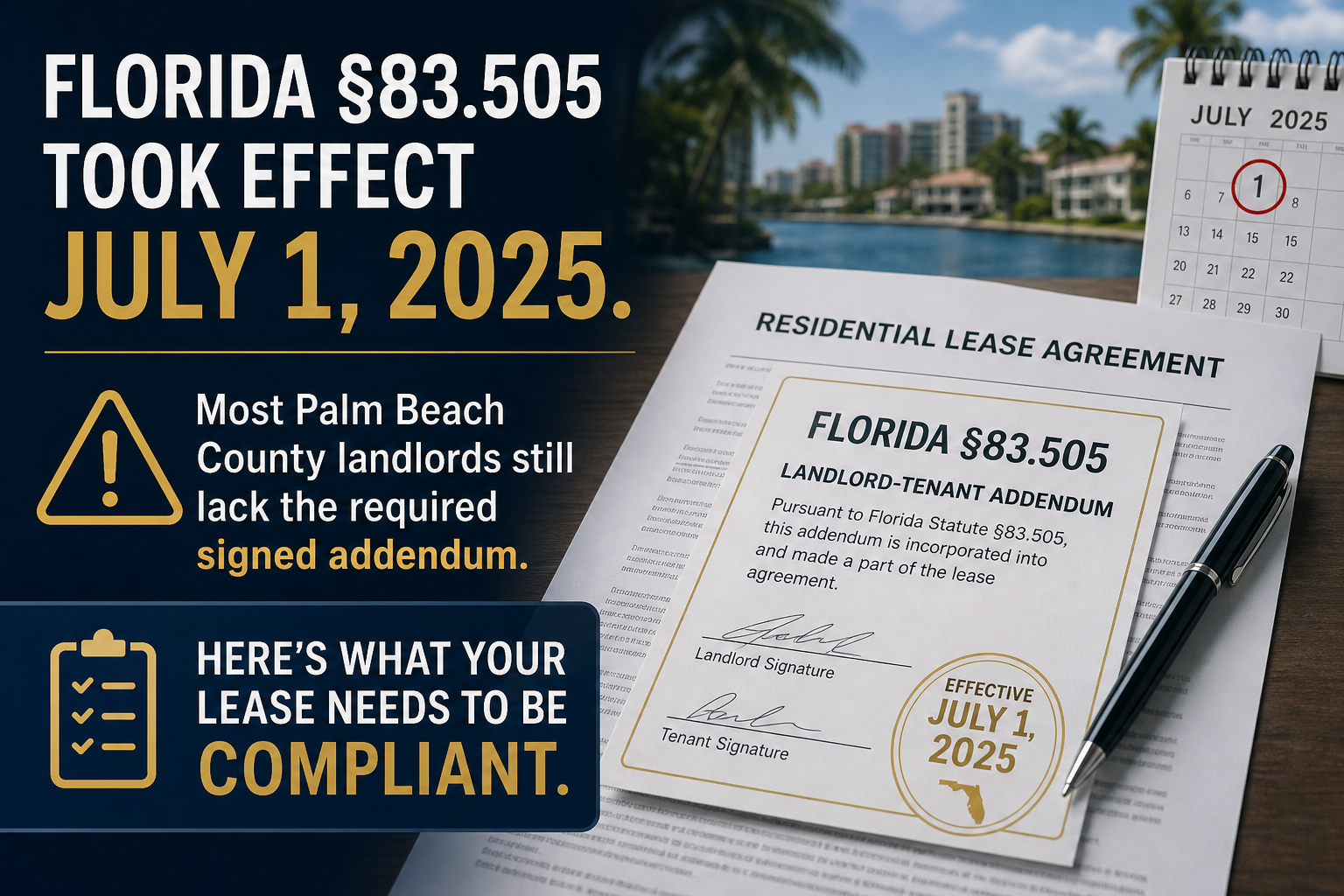
Florida Statute §83.505, created by HB 615 and effective July 1, 2025, allows landlords and tenants to send legally required rental notices by email — but only after both parties sign a written addendum separate from the lease that designates their email addresses and confirms the election is voluntary. The most common mistake: landlords emailing statutory notices after July 1, 2025 without a signed addendum in place. Every such notice is legally invalid, regardless of whether the tenant read and replied to it.
By Jean Taveras, Broker-Owner, Atlis Property Management · Published July 2025Updated July 1, 2026
On April 29, 2025, Governor DeSantis signed House Bill 615, creating Florida Statute §83.505 and establishing email as a lawful delivery method for required rental notices for the first time in Florida history. The law took effect July 1, 2025. One year later, Atlis has reviewed lease files across Jupiter, Palm Beach Gardens, and West Palm Beach. The consistent finding: the majority of self-managing Palm Beach County landlords have no signed §83.505 addendum. They are emailing statutory notices — some legally consequential — on an invalid basis. This guide covers every compliance requirement, the addendum language, and the five most common failures.
1. What Florida Statute §83.505 Actually Requires
The statute has a single gating condition: a signed written addendum, separate from the rental agreement itself. Verbal agreement, routine email history, and lease clauses do not qualify. Four requirements apply:
- Signed by both parties with each designating a valid email address for receipt of notices.
- Conspicuously states the election is voluntary — cannot be minimized or buried.
- Advises consent is revocable at any time by written notice, effective upon delivery.
- Structured as a separate addendum — Florida Realtors advises the consent language should not appear in the lease body. The statute specifies an addendum.
Once executed, the addendum authorizes email delivery under: §83.49 (security deposit notices), §83.50 (landlord address disclosure), §83.51 (pest control vacate), §83.56 (termination), and §83.575 (end-of-lease notices). Email notices are deemed delivered when sent unless they bounce; the sender must retain proof of transmission.
⚠ Three-Day Notices — Handle With Care
Three-day pay-or-vacate notices under §83.56 are technically covered by the email option once an addendum is signed — but they remain the most scrutinized notice in eviction proceedings. Atlis's practice: use traditional delivery (hand delivery, certified mail, or posting) as the primary method for three-day notices regardless of addendum status. Email alone for a three-day notice is a litigation risk Palm Beach County landlords should not accept.
| Notice Type | Statute | Email Eligible | Atlis Recommendation |
|---|---|---|---|
| Security deposit claim | §83.49 | Yes — with addendum | Email + retain proof of transmission |
| Landlord address disclosure | §83.50 | Yes — with addendum | Email acceptable |
| Pest control vacate notice | §83.51 | Yes — with addendum | Email acceptable |
| Lease termination / non-renewal | §83.56 / §83.575 | Yes — with addendum | Email + certified mail backup |
| Three-day pay or vacate | §83.56 | Yes — with addendum | Traditional delivery only |
| Service of process / eviction | F.R.C.P. | No | Process server required |
Source: Florida Statute §83.505 as enacted by HB 615 (2025). Consult a Florida real estate attorney for your specific situation.
2. The Specific Lease Addendum Language Landlords Need
The Legislature wrote the statutory form directly into §83.505. The addendum must be “in substantially the following form” and must include both the landlord election (receiving tenant notices) and the tenant election (receiving landlord notices). Both sections must be present. Below is the statutory language from the Florida Senate's published version of §83.505:
Landlord Election — Tenant Sends Notices to Landlord by Email
Notices from a tenant may contain time-sensitive information about the tenant's housing. The election to receive notices from the tenant by e-mail is voluntary. ☐ I, [landlord or landlord's agent name], the landlord or the landlord's agent, agree to receive notices required by the rental agreement or under part II of chapter 83, Florida Statutes, from the tenant by e-mail. Designated e-mail address for notices from the tenant: _______________________________________________________ I may revoke this agreement by providing written notice to the tenant. Revocation is effective upon delivery and does not affect prior valid notices. I may update my e-mail address by providing written notice specifying the new address. ☐ I do not agree to receive notices by e-mail. Landlord/Agent Signature: _____________________ Date: __________
Tenant Election — Landlord Sends Notices to Tenant by Email
Notices from a landlord may contain time-sensitive information about a tenant's housing. The election to receive notices from the landlord by e-mail is voluntary. ☐ I, [tenant name], the tenant, agree to receive notices required by the rental agreement or under part II of chapter 83, Florida Statutes, from the landlord by e-mail. Designated e-mail address for notices from the landlord: _______________________________________________________ I may revoke this agreement by providing written notice to the landlord. Revocation is effective upon delivery and does not affect prior valid notices. I may update my e-mail address by providing written notice specifying the new address. ☐ I do not agree to receive notices by e-mail. Tenant Signature: _____________________ Date: __________
✓ Key Point — Addendum vs. Lease Body
The §83.505 consent language must be in a separately signed addendum — not in Section 14 of the main lease. A landlord who embedded email consent language in their lease body after July 1, 2025 has not complied with the statute. Florida Realtors advises that, in an abundance of caution, this language should not appear in the lease itself.
Is your lease addendum §83.505-compliant?
Jean Taveras reviews lease files for Palm Beach County property owners. Licensed Florida Real Estate Broker CQ1071712. No commitment required.
Schedule a Lease Compliance Review with Jean →Get a Free Rental Analysis →3. The 5 Most Common §83.505 Compliance Failures in Palm Beach County
Failure 1 — No Addendum At All
The most common failure. Landlords who text and email tenants regularly assume mutual communication constitutes consent. It does not. Six months of email history is not a §83.505 addendum. Every statutory notice sent by email without a signed addendum since July 1, 2025 is legally invalid.
Failure 2 — Consent Embedded in the Lease Body
Lease platforms and template services updated their standard forms to include email consent language in a notices clause or communications paragraph. This fails the statute. The addendum must be a separately signed document — a court reviewing a deposit dispute will ask to see the addendum, not a lease clause.
Failure 3 — Only One Direction of Consent Signed
The addendum has two independent sections: the landlord election and the tenant election. Many landlords execute only one section and then email in both directions. Each direction requires its corresponding signed election.
Failure 4 — No Proof of Transmission Retained
Section 83.505 explicitly requires the sender to maintain a copy of every notice sent electronically and evidence of transmission. A notice sent from a personal Gmail account with no delivery confirmation or archived proof is legally sent — but unprovable in a dispute. Timestamped email management with retained sent-folder documentation is the minimum standard.
Failure 5 — Continuing to Email After Tenant Revokes Consent
Either party can revoke consent at any time by written notice, effective upon delivery. A tenant who mails a written revocation has validly revoked. Any email notices sent after revocation are invalid. Track revocations and shift delivery method immediately.
“All five failures share a common root: treating §83.505 as a convenience upgrade rather than a compliance statute with specific procedural conditions. Email notice is only as valid as the addendum behind it.”
— Jean Taveras, Broker-Owner, Atlis Property Management · FL Broker License CQ1071712
4. What Happens If You Serve Notice by Email Without a Proper Opt-In
Security Deposit Claims — §83.49 Consequences
Section 83.49 requires a landlord to send written notice of any claim against a security deposit within 30 days of the tenant vacating, using a legally valid delivery method. A landlord who emails this notice without a signed §83.505 addendum has sent no valid notice in the eyes of Florida law. The result: full forfeiture of the security deposit, regardless of documented damage or unpaid rent. On a $4,200/month Jupiter property with a two-month deposit, that is $8,400 in forfeited deductions traceable to a missing addendum.
Lease Termination and Eviction Timeline
A non-renewal or termination notice sent by email without a valid addendum does not start the notice clock. If a landlord emails a 60-day non-renewal notice in reliance on invalid email delivery, and the tenant refuses to vacate, the landlord must restart the notice period using a valid delivery method — extending the timeline and carrying cost. At $4,200/month, one additional month of timeline extension from a notice error costs $4,200 before eviction proceedings can begin.
Consequences at a Glance — Invalid Email Notice
- §83.49 security deposit claim notice invalid → full deposit forfeiture regardless of damage evidence
- Lease termination notice invalid → notice clock does not run → costly timeline restart
- Three-day notice via email alone → high eviction dismissal risk in PBC Circuit Court
- Revocation not tracked → all subsequent email notices invalid after revocation date
- No proof of transmission → notice unprovable even with valid addendum in place
5. Palm Beach County-Specific Considerations
HOA Notice Requirements Are Separate from §83.505
Jupiter and Palm Beach Gardens governed communities — PGA National, Abacoa, BallenIsles — impose notice requirements under Chapter 720 (HOAs) and Chapter 718 (condominiums), not Chapter 83. The §83.505 email authorization applies only to Chapter 83 notices. HOA tenant approval applications, violation cure notices, and lease compliance certifications remain subject to community-specific communication requirements. A signed §83.505 addendum does not extend to HOA correspondence.
The §83.49 Disclosure Language Was Also Updated
HB 615 updated the mandatory security deposit disclosure that landlords must provide at tenancy commencement. The revised language now references email as a permissible delivery method in accordance with §83.505. Lease move-in packages containing the pre-July 1, 2025 disclosure language are outdated and should be updated at the next lease renewal.
Oral Lease Tenancies Cannot Use §83.505
Month-to-month oral tenancies common in workforce housing submarkets in West Palm Beach and Boynton Beach cannot use email delivery under §83.505. The statute requires a written addendum to a rental agreement. An oral lease has no written agreement to attach an addendum to. Traditional delivery methods remain the only lawful option for these tenancies.
Every Atlis-managed unit. Every lease being updated for §83.505 compliance now.
Self-managing a Palm Beach County property and haven’t reviewed your lease addendum since July 1, 2025? Contact Jean directly.
Call Now — 561.473.3664 →Schedule a Lease Compliance Review →Frequently Asked Questions — Florida §83.505 / HB 615
What is HB 615 and what does Florida Statute §83.505 require?
HB 615 created Florida Statute §83.505, effective July 1, 2025. It permits email delivery of required rental notices only after both parties sign a written addendum separate from the lease designating their email addresses, with the addendum conspicuously stating that the election is voluntary and revocable at any time by written notice. Embedding consent in the lease body does not satisfy the statute.
Does HB 615 apply to all types of landlord-tenant notices in Florida?
HB 615 covers §83.49 (security deposit), §83.50 (landlord address), §83.51 (pest control vacate), §83.56 (lease termination), and §83.575 (end-of-lease notices). Three-day pay-or-vacate notices are technically included with a signed addendum but remain subject to heightened court scrutiny; Atlis recommends physical delivery for these regardless. Service of process and eviction pleadings still require physical delivery — HB 615 does not change that.
What happens if a Palm Beach County landlord sends an email notice without the signed addendum?
The notice is legally void. For §83.49 security deposit claims, a notice delivered by invalid email is treated as no notice at all, causing full deposit forfeiture regardless of documented damage. For termination notices, the notice clock never starts; the landlord must re-serve using a valid method, restarting the period and extending carrying costs before any eviction action can be filed.
Can the §83.505 email consent language appear in the lease body?
No. Florida Realtors and the Florida Senate both advise, out of an abundance of caution, that the consent language should not appear in the lease body itself. The statute calls for an addendum. A landlord who added email consent to Clause 18 of their standard lease has not created the separately signed addendum the statute requires and risks a successful challenge to any email notice they send.
Can a landlord add the §83.505 addendum to an existing lease mid-tenancy?
Yes. The addendum can be executed at any point during an active tenancy — not only at lease signing. Both parties sign and designate current valid email addresses. The addendum authorizes email delivery going forward from that date only; it does not cover notices already sent before execution. Atlis recommends executing at the next lease renewal for all existing managed properties in Palm Beach County.
How does HB 615 affect the §83.49 security deposit claim deadline?
With a signed §83.505 addendum, the 30-day §83.49 claim notice can be sent by email. Email is deemed delivered when sent unless it bounces, and the sender must retain proof of transmission. The 30-day deadline, itemization requirements, and the tenant’s 15-day objection window are unchanged. Landlords without a signed addendum must still deliver the claim notice in person or by mail within the same 30-day window.
About the Author
Jean Taveras — Broker-Owner, Atlis Property Management LLC
3801 PGA Blvd., Ste. 600, Palm Beach Gardens, FL 33410 · 561.473.3664info@atlispm.com
FL Real Estate Broker License CQ1071712 — verifiable at myfloridalicense.com
Jean manages residential properties across Palm Beach County. The legal content in this article is verified against the enrolled text of HB 615 and the Florida Senate’s published version of §83.505. This article is for informational purposes and does not constitute legal advice. Consult a licensed Florida real estate attorney for guidance specific to your situation.
Ready to Get Your Palm Beach County Leases §83.505-Compliant?
Atlis Property Management is updating every managed property lease file with a compliant §83.505 addendum. If you self-manage a Palm Beach County property and your lease hasn’t been reviewed since July 1, 2025, call Jean directly or schedule a compliance review online.
Schedule a Lease Compliance Review with Jean →Get a Free Rental Analysis →Call Now — 561.473.3664 →
info@atlispm.com3801 PGA Blvd., Ste. 600, Palm Beach Gardens, FL 33410 · FL Broker CQ1071712