
Multifamily Management Transition · Case Study · Fort Lauderdale Area, FL
What the first 45 days of a management transition actually look like — and why they decide the next 24 months.
Quick Answer
Atlis took over a 48-unit multifamily property in the Fort Lauderdale area, inside Oakland Park city limits with a Fort Lauderdale 33309 address, on August 17, 2026. By Day 48 the rent roll had held at 44 of 48 occupied (91.7%), a $143,906.14 escrow misstatement inherited from the prior books had been corrected with no resident balance changed, 72% of inherited pre-closing debt ($12,512.39 of $17,322.19) had been collected, and 42 of 48 residents were current. The method: three property walks, reconciliation to the closing statement, a re-contracted vendor bench, and owner reporting checked twice before it goes out.
By Jean Taveras, Broker-Owner, Atlis Property Management · Prepared October 4, 2026 (Day 48)
The asset
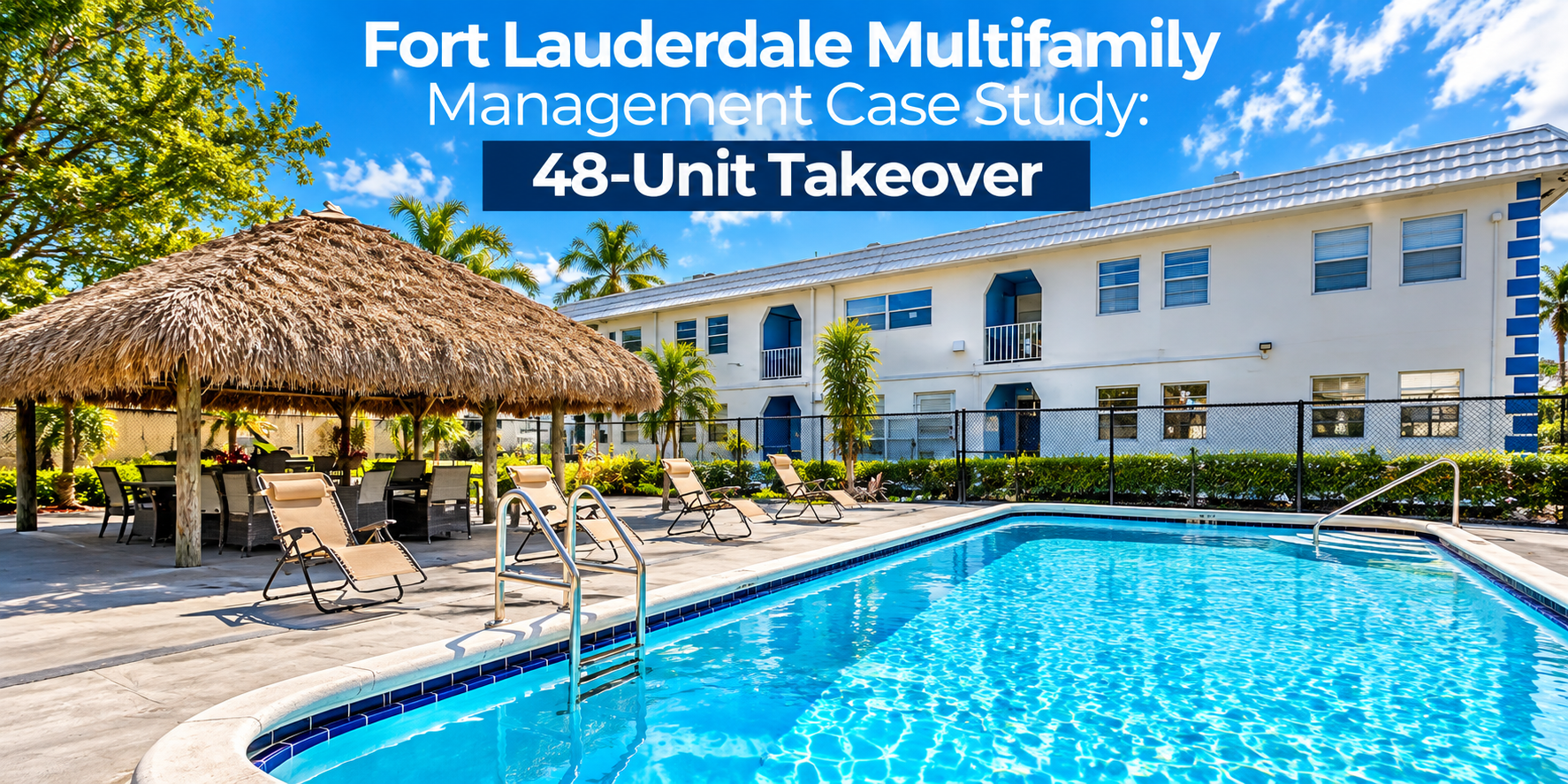
Two buildings, three structures, 48 units on W Prospect Road with a Fort Lauderdale mailing address (ZIP 33309), inside the city limits of Oakland Park, Broward County, and served by City of Fort Lauderdale water. It is the kind of address where Fort Lauderdale property management and Oakland Park rules overlap, managed under our multifamily property management program. A $9.1 million acquisition that closed Monday, August 17, 2026 as part of a 1031 exchange — which matters more than it sounds, because a 1031 buyer does not choose his closing date for operational convenience. He closes when the exchange clock says he closes.
The original date was Friday, August 14. It moved to Monday — "Friday closings are never a good idea," as the seller's manager put it. That small decision bought a full business week in which banks, utilities, vendors and courts were all answering their phones.
The asset came off a long-tenured local management company. Not a bad operator — a conventional one. That distinction is the subject of this case study: the gap between a conventional transition and a good one is invisible on day one and obvious on day four hundred.
Why the first 60 to 90 days decide the next 24 months
Every transition has the same physics. On closing day a property's residents, vendors and records belong to a relationship that no longer exists — and every one of them is quietly testing the new manager.
Residents test payment. If October rent is late and nothing happens, November will be later. A building's collection habit is set within about two billing cycles, and once set it takes a year of pressure to reset.
Vendors test authority. Whoever was overcharging the prior manager will try the same number once. Whoever was doing good work cheaply will quietly raise it. The first three invoices you answer set the cost basis for two years.
Records test everyone. Whatever is wrong at takeover gets harder to fix every month, because each month layers new transactions on the error. A deposit misposted at closing is a two-hour fix in week one and a forensic exercise in month six.
So we treat the first 60 to 90 days as a distinct operating mode. The goal is not to optimize but to establish — accurately, visibly, and fast enough that nobody forms a bad habit.
The property walks
We walk a new property three times in the first 60 days, deliberately differently.
The first is forensic, before we touch anything. We are not looking at condition; we are looking for what the prior manager stopped doing. Overgrowth tells you when landscaping went from contract to call. Standing water tells you about drainage nobody owned. A laundry room with two machines down tells you the revenue-share operator is not being managed. The condition report we inherited was written by someone who was selling, so we assume nothing.
The second is systems. Lift station, main water shutoff, electrical service, irrigation, pool equipment, trash enclosures, roof access — where is it, does it work, who services it, is there a contract. This walk produces the capital plan.
The third is with the owner, scheduled last on purpose, so we answer questions instead of taking them.
The systems walk here produced a finding we are still working: nobody can locate the main water shutoff valve — not our team, not the residents, not the prior manager. On 48 units that is not housekeeping. If a supply line fails at two in the morning there is no way to stop the water without the city. It is most likely buried under years of overgrowth, which is why it is sequenced behind a vegetation clearing rather than ahead of it. You do not find that in a condition report.
Hyper-local: a Fort Lauderdale address, Oakland Park rules
The property sits in Oakland Park. Its water comes from the City of Fort Lauderdale. Its trash comes from the City of Oakland Park at one building and a private hauler at the other. Three municipalities on one parcel, each a way to get something wrong.
Since March 1, 2026, only property owners can establish new utility billing accounts with the City of Fort Lauderdale. Existing tenant accounts stay as they are unless service is disconnected, and owner accounts can have bills sent in care of the manager, but new service must be opened by the owner. A resident cannot open water service in their own name.
Verified on the city's own site, and it quietly rewrites the economics of every Fort Lauderdale-served rental. The owner holds water and sewer. Every move-in packet telling a resident to "call the city and set up water" is wrong and will generate a service call. And RUBS — ratio utility billing — stops being an optimization and becomes the only mechanism by which the owner recovers water cost at all.
We rebuilt resident onboarding around that rule, by municipality, each start-service page verified rather than assumed. For a Palm Beach County comparison: Lake Worth Beach, where we provide property management as well, is a citizen-owned municipal utility providing both electric and water on one application — it is not FPL, and a packet that says FPL sends the resident in a circle.
None of this is in a management agreement. All of it decides whether a resident's first week is smooth or infuriating — and that first week predicts whether they renew.
The goals
- Do not lose the collection habit. Hold the rent roll through the transition rather than rebuilding it after.
- Make the books true — reconcile to the closing statement to the cent before layering a second month on top.
- Re-contract the vendor bench: insurance, scope, written approval thresholds.
- Produce one capital plan the owner can decide from, not a stream of approval requests.
Days 1–10Stabilize and inherit cleanly
Almost entirely continuity, almost none of it visible to the owner. Every resident gets a transition notice naming the new manager, the new payment portal, and the date the old payment method stops working. It sounds trivial; it is the highest-leverage action in a transition, and where most collection loss originates. A resident who sends a check to the old manager in month one has learned that payment is ambiguous.
In parallel: ledger import and reconciliation, resident contact cleanup, portal invitations, deposits reconciled against the closing statement, insurance certificates from every inherited vendor, and legal files triaged for running clocks. One arrived with a clock already running — a resident under a court-approved stipulation filed before we took over (our guide to the Florida eviction process explains how those clocks work). A stipulation deadline does not care that the building changed hands.
Days 11–15The deposit reconciliation
This is where transitions quietly go wrong. At closing the owner retained every resident deposit — normal in a 1031 purchase — and they were correctly recorded as liabilities to residents: $74,187.50 in security deposits across 45 leases, $64,742.50 in last month's rent across 38, and $2,200 in pet deposits across 5. $141,130.00 owed back to residents, plus $2,776.14 of prepaid rent.
But the offsetting entries had been booked as 93 cash receipts into the security deposit bank account — recording $143,906.14 arriving in escrow that never arrived, because the owner had kept it. Resident ledgers were right. Owner liability was right. The cash side was fiction.
For a Florida broker this is not a bookkeeping preference. Escrow integrity is a licensing matter under Chapter 475 of the Florida Statutes, and an account reporting funds it does not hold is a problem regardless of how it got that way.
We did not improvise. We took it to the platform's accounting team, got the method confirmed in writing, then executed by hand: 93 receipts voided, 50 replacement credits posted against owner distribution, $143,906.14 total. Not one resident's balance changed. Not one dollar the owner holds changed. The platform's own escrow-mismatch diagnostic, which had been flagging this ledger, now reads clean.
Day 15 is early to find a six-figure escrow misstatement. Month six would have been late.
Days 16–30Vendors, and the first real decisions
Forensics give way to procurement. Every inherited vendor was asked for the same four things: a certificate naming both the owning entity and the manager as additional insureds, written scope, a written approval threshold, and a signed addendum binding all three.
Some signed immediately. One addendum is overdue with the signatory out of office. One vendor told us flatly they would not raise general liability from $1M to $2M and would stop servicing the pool if we insisted. We kept them, at their current limit, with both entities named.
That runs against our own standard. Losing a reliable pool contractor days before the owner's site visit, over an insurance limit, is the worse trade — so we made the call, documented it as a departure, and told the owner rather than letting him discover it. A company that never deviates from its own policy is either not paying attention or not telling you when it does.
Where we went to market rather than inheriting, we went wide: six licensed Broward electricians, priced under our no-markup maintenance guarantee, on service-meter and irrigation work, three locksmiths on a 48-unit rekey, three pest control firms, two drainage contractors on the parking lot.
Days 31–45Diagnosis over reaction
Month two is where a transition becomes operations or becomes firefighting. The difference is whether you are still answering questions you should have asked in week two.
The parking lot is the clearest example. It floods. The obvious theory was the sanitary lift station, and there was a $6,530 monitoring proposal on the table an owner could easily have approved believing it addressed the flooding.
It does not. We put the question in writing and got it back in writing: the storm water collection system is entirely separate from the sanitary sewer, and only sanitary sewer enters the lift station. The monitoring covers the lift station only — meaning nobody, including the prior manager, held the storm drain scope at all.
That is a $6,530 decision that would have bought something real and solved nothing visible, followed months later by an owner reasonably asking why the lot still floods. Instead the monitoring is decided on its own merits, and the flooding went out as its own scope: blocked line, catch basins, grading, or outfall.
We also held one item back deliberately. A full HVAC inventory requires entering all 48 units, and so does the rekey — doing the inventory first means disturbing 44 households twice and handing the owner a partial document now and a corrected one later. So it rides along with the rekey, and we told him that is why he does not have it yet. Sequencing is not delay. Unexplained sequencing is.
Where it stands at Day 48
| Occupancy | 91.7% — 44 of 48 |
| Total resident arrears | $12,378.38 · 6 of 48 leases |
| Concentration — 2 leases in legal process | $8,615.86 · 70% |
| Remaining four leases | $115.45 · $778.15 · $872.24 · $1,996.68 |
| Pre-closing balances inherited | $17,322.19 → $4,809.80 |
| Collected on inherited debt | $12,512.39 · 72% |
| Escrow reconciliation | $143,906.14 · diagnostic clean |
| Open work orders | 19 — 3 administrative, 16 repairs |
| Work orders handled since takeover | 69 |
The shape matters more than the total. $12,378.38 across 48 units is a number. Six residents of forty-eight, 70% of the balance on two files already in front of a judge, and one of the rest waiting on a third-party housing assistance payment rather than on the resident — that is a diagnosis. Forty-two of forty-eight are current. The rent roll held, which was goal one.
The inherited-debt recovery is the number most owners never think to ask about. Pre-closing balances are owed to a company that no longer manages the resident, for a period before the new owner existed — the conventional outcome is a quiet write-off. We recovered $12,512.39 of $17,322.19, and only two residents still carry any. We also name what is unresolved: whether those receivables belong to the buyer or the seller is a closing-document question, and we raised it rather than letting it look like ordinary income.
The friction, honestly
Any case study describing a transition as smooth is describing one that did not happen.
The prior manager's records are a hypothesis, not a source. Lease end dates that never recorded month-to-month conversions. Deposits booked as cash never received. A trash arrangement where one building is on private contract and the other on municipal service, with costs pooled rather than billed to the building that incurred them.
Residents test the new manager, and some tests are strategic. Some tests are timed. When a resident in active legal proceedings submits a burst of maintenance requests, we inspect and document every one on its merits, because the worst available outcome is handing anyone a habitability argument. We also keep counsel informed. Both things are true at once.
Some friction is self-inflicted. We told the owner a lift station repair was scheduled for October 1. A rain event stopped it and it slipped a day. We put the correction in the next owner update in our own words rather than letting him find it on site. Small, but the habit is the point: an owner who hears about slippage from you keeps reading your reports.
How AI is actually integrated
Not as a chatbot, but as a verification layer whose job is to disagree with us. Our platform, the same system behind our 24/7 AI-assisted maintenance triage, runs continuously against the management system's live API, and every number that reaches an owner is derived independently at least twice — different endpoints, different directions. If two derivations disagree, the number does not go out until we know why.
That is not theoretical. The $143,906.14 escrow misstatement surfaced from a reconciliation that compared recorded deposit receipts against the closing statement and refused to accept the match. On the first move-out, a departing resident's last month's rent paid her final month but the owner-held liability was never drawn down — leaving $1,795 at risk of being refunded twice. A human reading that ledger sees a paid balance; a third derivation disagreed with the first two by exactly $1,795.
What AI does not do is talk to residents unsupervised, approve spending, or make a judgment call on an owner's money. On that $1,795 liability — with a statutory 30-day clock running under Section 83.49 — the system flagged it, quantified it, and stopped. The correct entry is a question for the accounting team, not for an inference.
AI lets a 48-unit property receive the analytical attention of a 480-unit property, and makes an owner report something checked rather than typed.
Days 48–60Close the open decisions
The owner site walk is the hinge. Ten decisions go in with a recommendation and a cost attached — among them the rekey award, lift station monitoring, turn scope, pool repairs, landscape contract, common areas, asking rent, pest contract, HVAC sequencing. The target is to leave with every one decided: not discussed, decided, with a number and a date.
Days 60–90Convert to a rhythm
Transition mode ends, and the shift should be visible as a change in what arrives in the owner's inbox: one concise weekly update — vacancies and leasing, collection exceptions, work completed, work open, decisions needed — that does not duplicate what the platform already shows him, with every approval request carrying a recommendation, cost, scope and deadline.
Operationally: full RUBS implementation, now that the Fort Lauderdale owner-only rule makes it the sole water-recovery mechanism; drainage awarded and executed; vacant units turned and leased; and the first renewal cycle — the real test of whether residents experienced the transition as an upgrade.
Days 90–120Capital plan and a real baseline
By day 90 there is enough operating history to build a budget from observation rather than from the seller's pro forma — the first moment an owner can make genuinely informed capital decisions. Roof, HVAC schedule by unit, parking lot and drainage, exterior, amenity: each with a condition basis, a cost, a consequence of deferral and a recommended year. A three-year calendar he can finance against rather than react to.
120 days and beyondThe 24-month thesis
All of it serves one proposition: a property correctly established in its first 90 days compounds. One that is not, decays.
By month four the collection habit is set — here at 42 of 48 current, the exceptions in documented legal or subsidy processes rather than drifting. The vendor bench is contracted, insured and competitively priced. The books reconcile to the closing statement. The capital plan is observed rather than assumed. And the owner receives a report he has learned to trust, because it corrected itself the one time it was wrong.
From that baseline, years two and three are actual asset management — renewal strategy, rent positioning, capital sequencing, expense ratio. From a bad baseline, they are spent re-litigating year one.
The broader point. We operate across Palm Beach, Broward, Martin and St. Lucie counties, from Pompano Beach and Fort Lauderdale north,, and this playbook does not change between a 48-unit Broward community and a scattered-site Palm Beach County portfolio. Only the local layer changes — which utility, which municipality, which inspection regime, which court. The discipline underneath is identical: inherit nothing on faith, reconcile to a primary source, contract the vendor bench, walk the asset three times, and set the owner's reporting rhythm before anyone forms a habit you will have to break.
Most management companies are judged on month eighteen. They are decided in month two.
Frequently Asked Questions
Is this property in Fort Lauderdale or Oakland Park?
Both, in different senses. The property's mailing address is Fort Lauderdale, ZIP 33309, and its water comes from the City of Fort Lauderdale, but it sits inside Oakland Park city limits, so Oakland Park handles code and municipal trash at one building. Both cities are in Broward County. Knowing which city controls which service is a large part of managing Fort Lauderdale-area multifamily well.
How long does a property management transition take?
The core transition runs about 90 days. In this Oakland Park case, Days 1 to 15 covered resident notices, ledger import, and the deposit reconciliation; Days 16 to 45 covered vendor contracts and diagnosis; and Days 48 to 90 covered the owner decisions and a weekly reporting rhythm, with a capital plan built from observed data by about Day 120.
What should an owner check when switching property managers?
Reconcile every resident deposit and prepaid balance to the closing statement, confirm each resident received a transition notice with the new payment method, collect insurance certificates and written scopes from every vendor, and triage legal files for deadlines already running. Those four steps prevent most of the losses that surface months later.
Who can open a water account for a Fort Lauderdale-served rental?
Since March 1, 2026, only the property owner can establish a new utility billing account with the City of Fort Lauderdale. Existing tenant accounts stay in place unless service is disconnected, and bills on owner accounts can be sent in care of the property manager.
What happens to rent owed to the prior manager?
Balances from before closing are owed for a period before the new owner existed, and they are often quietly written off. In this case Atlis recovered $12,512.39 of $17,322.19 by Day 48, and raised with the owner the separate question of whether those receivables belong to the buyer or the seller under the closing documents.
How does Atlis use AI in property management?
As a verification layer, not a decision-maker. Every number that reaches an owner is derived at least twice from the management system's live data; if the derivations disagree, the number is held until the discrepancy is explained. AI does not talk to residents unsupervised, approve spending, or make judgment calls on an owner's money.
What does Atlis charge to manage a multifamily property?
Management is 5 to 9 percent of collected rent with a $200 monthly minimum, full service only, with no fee on vacant units and the rate locked for the life of the partnership. Larger multifamily assets are quoted individually after a property review.
Related Case Studies and Resources
See how the same discipline applies elsewhere: our 8-property portfolio onboarding in 21 days, the West Palm Beach triplex rent collection turnaround, and $14,000 in maintenance costs saved in 12 months. Owners evaluating a switch can review our published pricing and eight written guarantees, or browse all Atlis case studies.
Sources
- City of Fort Lauderdale Utility Billing: owner-only new accounts effective March 1, 2026
- ZIP Code 33309: primary USPS city Fort Lauderdale; Oakland Park an accepted name
- Florida Statutes §475.25, broker discipline including escrow
- Florida Statutes §83.49, deposit money or advance rent
- City of Lake Worth Beach (municipal electric and water utility)
All property figures are from Atlis management records as of October 4, 2026. Resident identities and individual case details are withheld.
About the Author
Jean Taveras is the Broker-Owner of Atlis Property Management (FL Brokerage CQ1071712), a broker-led residential management firm headquartered at 3801 PGA Blvd., Suite 600, Palm Beach Gardens, serving Palm Beach, Broward, Martin and St. Lucie counties. Every account is backed by eight written guarantees. Questions about a transition: 561.473.3664 or info@atlispm.com.