40-Unit Multifamily Case Study · West Palm Beach, Florida
Turning Around a Reactive Multifamily Operation:
A West Palm Beach Property Management Case Study
How Atlis Property Management transformed a 40-unit West Palm Beach multifamily asset from an over-managed, under-performing operation into a structured, predictable, and professionally run investment.
Overview
There is a version of multifamily ownership that most privately held properties fall into at some point: the property is well-located, the fundamentals are solid, the market is producing demand — and yet the investment consistently underperforms relative to what it should deliver. Not because of the asset itself, but because of the operation behind it.
This case study documents how Atlis Property Management stepped into exactly that situation at a privately owned 40-unit multifamily property in West Palm Beach, Florida. The property sat within a strong rental market with genuine demand drivers, yet operational inefficiencies were eroding performance across every measurable dimension — leasing, maintenance, tenant satisfaction, and owner involvement. The asset had the potential of a well-run investment. The management structure had not kept up with that potential.
Atlis was engaged to close that gap — implementing a structured, system-driven management approach that transformed the property from a reactive, owner-dependent operation into a stable, professionally managed asset operating on a foundation designed for long-term consistency and growth. What follows is an account of how that transformation happened and what it means for multifamily owners across West Palm Beach facing similar conditions.
The Property & Ownership Objectives
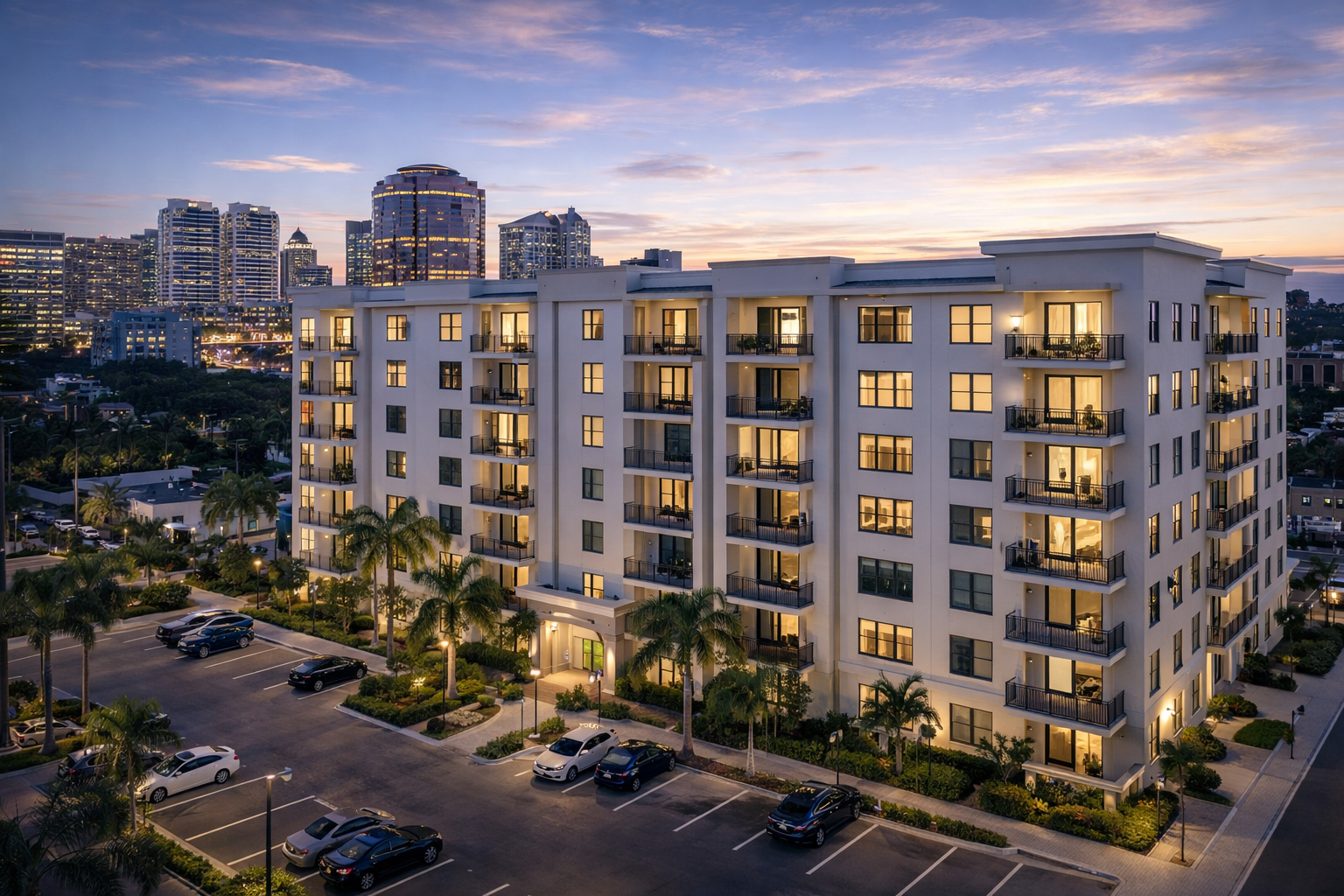
The subject property is a 40-unit multifamily asset located near downtown West Palm Beach — a position that places it within one of the most active rental submarkets in Palm Beach County. Downtown West Palm Beach and its surrounding neighborhoods have undergone significant investment and population growth over the past decade, driven by employer relocation, infrastructure development, and a wave of in-migration from higher-cost markets. Rental demand in this corridor is structurally strong, with a tenant base that includes young professionals, workforce households, and long-term residents who value proximity to employment, transit, and the downtown amenity base.
The property itself represented what market analysts often describe as a “value-add” opportunity — not necessarily in the physical sense of requiring renovation, but in the operational sense. The asset had strong bones and a favorable location. What it lacked was the management infrastructure to translate those advantages into consistent financial and operational performance.
The owner’s objectives going into the engagement were direct:
- Significantly reduce day-to-day personal involvement in property operations
- Improve operational efficiency across maintenance, leasing, and tenant communication
- Enhance the tenant experience to support retention and reduce costly turnover
- Establish clear, consolidated visibility into property performance without requiring constant direct oversight
- Stabilize and protect long-term asset value by replacing reactive management with structured systems
- Create a management foundation scalable enough to support the owner’s broader portfolio ambitions
Hyperlocal Spotlight: Ibis Golf & Country Club, West Palm Beach
Ibis Golf & Country Club in West Palm Beach represents one of the most active rental submarkets in Palm Beach County for the specific considerations covered in this guide. Current rental rates in Ibis Golf & Country Club range from $2,700–3,900/month for single-family and townhome inventory, with demand driven primarily by corporate transferees, dual-income households, and long-term residents seeking stability in a well-maintained community.
Landlords operating in Ibis Golf & Country Club face the full complexity of West Palm Beach's rental environment: HOA compliance requirements, a tenant pool with above-average income and expectation standards, and seasonal demand variation that rewards landlords who price accurately and market professionally. Atlis currently manages properties throughout Ibis Golf & Country Club and the broader West Palm Beach submarket, with an average days-to-lease of under 21 days for properly prepared and priced units. Owners in this community who contact Atlis receive a no-obligation rental analysis specific to Ibis Golf & Country Club market conditions — not a county-wide estimate.
The Challenge
The operational gaps present at this property are not unusual for privately held multifamily assets in West Palm Beach — particularly those that have grown beyond what a single owner or small team can effectively manage without dedicated systems and professional infrastructure. Each of the following challenges existed independently, but they also reinforced one another, creating a cycle of reactive management that was difficult to break without an external intervention.
Inconsistent Maintenance Coordination
Maintenance requests were handled without a defined system. Vendor engagement was ad hoc, response times were unpredictable, and there was no structured framework for tracking open issues or holding vendors accountable. Repairs were reactive by default — problems were addressed after they escalated rather than before, resulting in higher costs, longer resolution times, and tenant frustration that compounded over time.
Delayed & Inconsistent Tenant Communication
Residents experienced slow follow-ups, unclear maintenance timelines, and a general sense that their communication with management was unreliable. In a 40-unit building, communication inconsistency does not stay contained to individual units — it spreads through the tenant base, eroding trust across the property and directly increasing the likelihood that residents begin looking elsewhere at renewal time.
Inefficient & Unstructured Leasing
The leasing process lacked the structure to consistently attract, qualify, and place high-quality tenants. Marketing presentation was inconsistent across units, application processing was slow and manual, and tenant screening lacked standardization. The result was a leasing operation that prioritized filling vacancies over placing the right residents — a tradeoff that generated short-term occupancy at the cost of longer-term stability and increased turnover.
No Defined Operational Systems
There were no clearly defined workflows for maintenance tracking, vendor coordination, tenant communication, or performance reporting. Every decision required manual intervention, and without documented processes, the property’s operational performance was entirely dependent on whoever was paying attention at any given moment. This kind of person-dependent management cannot scale and cannot be replicated consistently over time.
Limited Owner Visibility & Excessive Involvement
Because there was no organized reporting structure, the owner lacked clear insight into what was actually happening at the property — leasing pipeline status, open maintenance items, vendor activity, and financial performance. The absence of structured reporting had a counterintuitive effect: rather than reducing owner involvement, it increased it, because the owner was required to stay personally engaged just to maintain basic situational awareness.
Free Service · No Obligation
Free West Palm Beach Rental Analysis From Atlis
See what your West Palm Beach rental should command in today's market — with live comparable data from Atlis's active portfolio.
Get My Free Rent Analysis3801 PGA Blvd., Suite 600, Palm Beach Gardens, FL 33410 · (561) 473-3664
Rent Growth Trends: Palm Beach County Submarkets 2023–2025
Rent growth in Palm Beach County has not been uniform. Submarkets diverged meaningfully between 2023 and 2025, creating investment opportunities in some areas and softening conditions in others. This data helps owners benchmark their pricing strategy.
Palm Beach Gardens (3BR SFH) 2023–2025
West Palm Beach (3BR SFH) 2023–2025
Boynton Beach (3BR SFH) 2023–2025
Boca Raton (2BR condo) 2023–2025
+9.2%
+6.8%
+5.1%
+7.3%
—
—
—
—
HOA-community demand from corporate transfers
Solid growth, more supply pressure than north county
Affordable tier remains in demand but growth is slower
Luxury condo segment recovered after 2024 softening
Strategy & Implementation
Atlis Property Management implemented a comprehensive operational restructuring built around five core pillars. The goal was not to patch the existing operation but to replace its foundations — installing professional management infrastructure that could deliver consistent results independent of any individual’s daily involvement.
1. Operational Restructuring & Systems Implementation
The first priority was establishing defined workflows across every core management function. Maintenance request intake, vendor assignment, work order tracking, and resolution confirmation were systematized into a clear, accountable process. Vendors were organized into a structured network with defined response time expectations and performance standards. Issue tracking was centralized so that nothing fell through the cracks and ownership could see the status of any open item at any time. This shift from reactive to structured operations was the foundational change that made every other improvement possible.
2. Leasing Optimization & Tenant Quality Focus
The leasing process was rebuilt from the ground up. Unit presentation was standardized and enhanced across the property — professional photography, improved listing copy, and consistent marketing across appropriate rental platforms. Application processing was streamlined to reduce friction for qualified applicants without sacrificing screening rigor. Tenant screening was standardized with defined criteria applied consistently across all units, shifting the focus from vacancy elimination to qualified placement. A shorter vacancy is less valuable than a longer tenancy — and this reframing drove leasing decisions throughout the engagement.
3. Tenant Communication & Experience Improvement
Communication systems were redesigned to deliver consistent, timely, and professional interactions at every resident touchpoint. Service request acknowledgment timelines were defined and enforced. Maintenance updates were communicated proactively rather than only in response to follow-up inquiries. Move-in, maintenance, renewal, and move-out processes were all structured to deliver a predictable, professional experience that residents could rely on. In a competitive rental market like West Palm Beach, tenant experience is a retention tool — and retention is significantly more cost-effective than replacement.
4. Proactive Maintenance & Property Condition Management
The shift from reactive to proactive maintenance required both a cultural and a structural change. Scheduled property inspections were implemented across all units and common areas, allowing early identification of issues before they became costly emergency repairs. Preventative maintenance schedules were established for key building systems — HVAC, plumbing, electrical infrastructure, and exterior components. This approach reduced emergency repair frequency, controlled long-term maintenance costs, and improved the overall physical condition of the property in ways that directly supported both tenant satisfaction and asset value.
5. Owner Reporting, Transparency & Reduced Direct Involvement
Structured reporting and communication protocols were established to give the owner complete visibility into property performance without requiring active participation in operations. Regular consolidated reports covered leasing activity, maintenance status, financial performance, and key operational metrics. Defined escalation thresholds were set so that ownership was automatically involved when decisions exceeded a predetermined scope — and not involved when they did not need to be. This structure accomplished the owner’s primary objective: full transparency paired with dramatically reduced day-to-day involvement.
The Results
The operational transformation produced measurable improvements across every dimension of the property’s performance. The results were not the product of a single intervention but of a comprehensive systems overhaul that changed how the property operated at its foundation.
Reduced Management Friction
Owner involvement decreased significantly as structured systems replaced manual oversight and reactive decision-making at every level.
Improved Tenant Satisfaction
Faster response times, clearer communication, and consistent follow-through produced a stronger resident experience and improved retention rates.
Organized, Predictable Operations
Maintenance, leasing, and communication became consistent and efficient — eliminating the delays and gaps that had previously defined day-to-day operations.
Increased Owner Confidence
With clear reporting and consistent execution, the owner gained real confidence in the property’s management and its long-term performance trajectory.
Stronger Asset Stability
The property now operates on a management foundation built for scalability, consistency, and sustained long-term value preservation.
Free 30-Minute Consultation
Questions About Your Palm Beach County Rental? Schedule a Free Call
Jean Taveras answers your specific questions directly — no sales team, no scripts. Pick a time that works for you.
Schedule My Free ConsultationPick a time that works for you · Jean typically responds within 1 business day
Common Mistakes Mid-Size Multifamily Owners Make in West Palm Beach
The operational gaps documented in this case study are not unique to this property. They appear consistently across privately held multifamily assets in West Palm Beach — and understanding why they develop is the first step toward preventing or correcting them.
Scaling Operations Without Scaling Systems
What works for a 4-unit property does not work for a 40-unit one. Many owners reach mid-size multifamily through gradual acquisition and bring the same informal management habits with them — direct vendor relationships, ad hoc communication, manual tracking. At scale, these habits become structural liabilities. The operational complexity of 40 units demands professional systems, not just more hours.
Filling Vacancies Rather Than Placing Tenants
The pressure to eliminate vacancy quickly leads many owners to compromise on screening. A lower-quality tenant in a 40-unit building is not just a single-unit problem — late payments affect cash flow across the portfolio, problematic behavior affects neighboring residents and increases turnover, and maintenance abuse increases capital costs. The cost of one poor placement at scale is a multiple of what it would be in a small asset.
Treating Tenant Communication as Overhead
Responsive, professional communication is not a nice-to-have at a 40-unit property — it is a retention strategy. Each non-renewal represents a turnover cost that includes vacancy loss, marketing expense, unit preparation, and leasing time. Across a 40-unit asset, even a modest improvement in retention rates has a material impact on NOI. Communication investment pays for itself directly through reduced turnover.
Deferring Maintenance Until It Becomes Emergency Repairs
Deferred maintenance is one of the most expensive decisions in multifamily ownership — it just does not always announce itself immediately. A minor HVAC issue deferred across a dozen units becomes a major capital replacement cycle. A roof maintenance item deferred for one season becomes a water intrusion event. Preventative maintenance is not a cost; it is a mechanism for controlling future capital exposure across the entire asset.
Remaining the Last Line of Defense in Operations
Many owners of mid-size multifamily properties remain personally involved in day-to-day decisions not by choice but because their management structure is not capable of operating without them. This is a significant and underappreciated risk. Owner availability is not a management system. Personal involvement is a finite resource, and when it runs thin — through travel, health, other projects, or simply time — operations deteriorate. A property that cannot run without the owner is not an investment; it is a job.
Who This Applies To
This case study is directly relevant to a broad range of West Palm Beach multifamily property owners:
- Owners of mid-size multifamily properties (20–80 units) in West Palm Beach who suspect their asset is underperforming relative to its location and market fundamentals
- Private landlords who have outgrown self-management and are spending more time operating the property than making strategic decisions about it
- Out-of-area investors with West Palm Beach multifamily holdings who need a trusted, structured management operation in place rather than relying on remote oversight
- Owners preparing for a value-add exit who understand that documented operational performance and stabilized tenancy are critical to achieving target sale pricing
- Multi-property owners looking to consolidate management across their portfolio under a single professional operation with consistent systems and reporting
- First-time multifamily investors who acquired a 20–50 unit asset and want to establish professional management infrastructure before operational problems develop
Why West Palm Beach Is a Distinct Multifamily Market
West Palm Beach has undergone a structural transformation over the past decade that has meaningfully changed the dynamics of its multifamily market. The downtown corridor, once underinvested relative to its South Florida peers, has attracted significant commercial, hospitality, and mixed-use development — bringing with it an influx of higher-income residents, corporate tenants, and long-term renters who have raised the bar on what they expect from the properties they inhabit.
This market evolution has important implications for multifamily owners. A tenant base that once tolerated reactive management and inconsistent service now has alternatives. New construction product at the top of the market has established a service and experience standard that percolates down the quality spectrum — meaning that even workforce and mid-market renters expect more professionalism, faster communication, and better-maintained properties than they did five or ten years ago. Properties that do not meet this elevated standard face higher turnover, more difficult leasing cycles, and widening performance gaps relative to comparably located assets that are professionally managed.
West Palm Beach also has a significant base of privately held multifamily assets — properties acquired by individual investors and family offices over multiple decades, often with limited management infrastructure and minimal technology adoption. These assets are not poorly located or fundamentally flawed. They are operationally behind. The opportunity they represent is exactly what this case study documents: the gap between what a well-located West Palm Beach multifamily asset can produce and what it currently produces due to a lack of structured professional management.
Atlis Property Management operates throughout West Palm Beach, Jupiter, and Palm Beach County with deep familiarity with the local multifamily market, its tenant demographics, its regulatory environment under Florida landlord-tenant law, and the operational standards required to manage effectively at every scale from boutique to mid-size portfolio.
Landlord Scenario: A Real Palm Beach County Owner's Experience
Let’s Get in Touch
If you own a multifamily property in West Palm Beach and are looking to improve operations, reduce your personal involvement, and protect your asset’s long-term value, Atlis Property Management is ready to help.
Call or text: 561.473.3664 · Email: info@atlispm.com · Visit: atlispm.com