
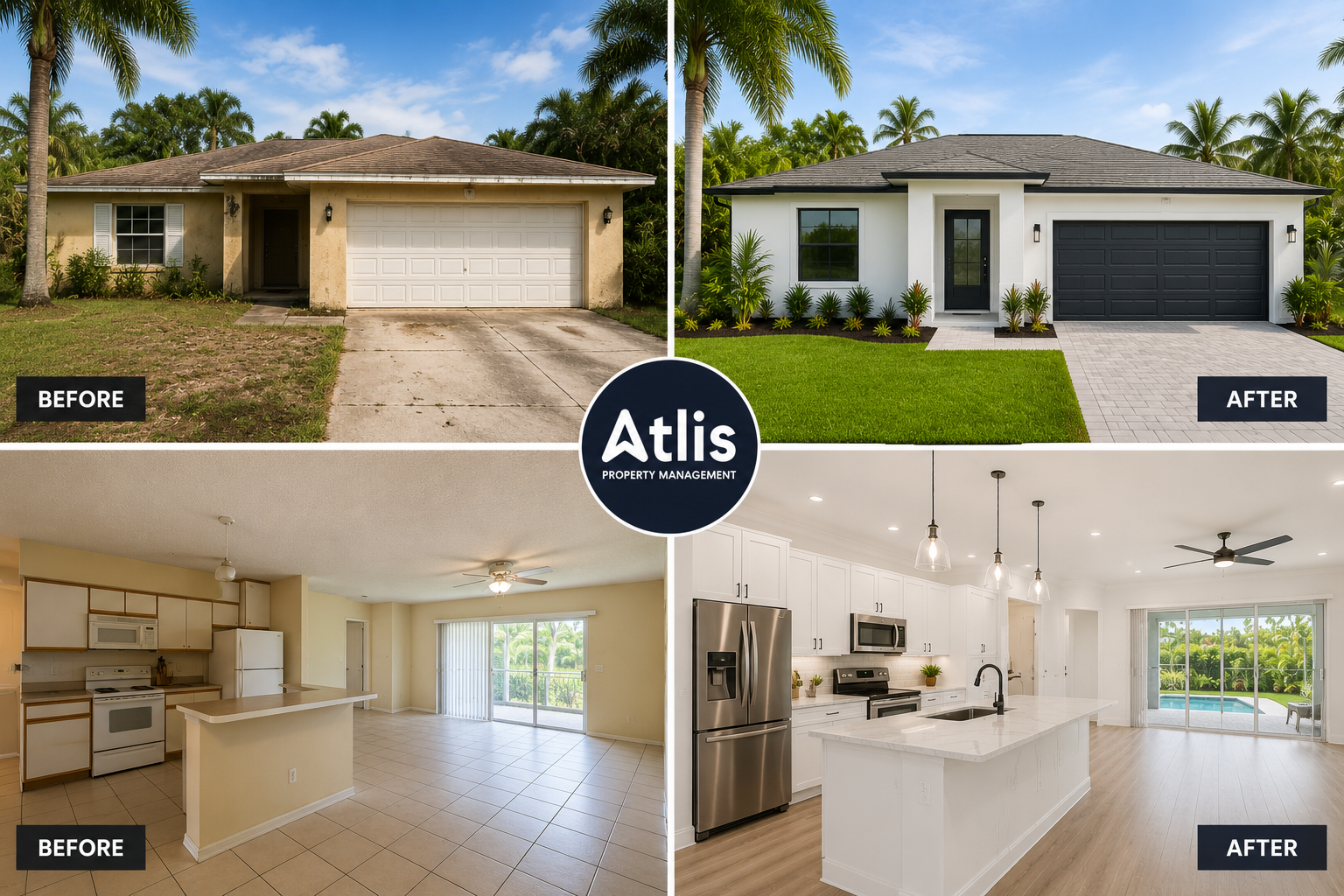
Jupiter & Palm Beach County Investor Guide · Value-Add Strategy · NOI Optimization · 2026
Maximizing ROI: Value-Add Opportunities in Jupiter and Palm Beach County Rental Properties in 2026
Quick Answer
Value-add in South Florida multifamily is not about granite countertops and stainless appliances. It is about the gap between current NOI and stabilized NOI — and in 2026, the widest gaps are in three categories: below-market rents on long-held properties (the single biggest NOI lever in Palm Beach County), expense bloat from unoptimized insurance, management, and maintenance costs, and operational failures like high vacancy and poor renewal rates that bleed income without appearing on any renovation budget. The investors generating the best returns on Palm Beach County multifamily in 2026 are not the ones spending the most on renovations. They are the ones fixing what the prior owner was too busy or too comfortable to address.
By Jean Taveras, CEO & Broker-Owner, Atlis Property Management · Updated June 2026
Value-add is the most overused phrase in multifamily investment and the most underexecuted strategy. Most investors define it as renovation — put $15,000 into a unit, raise rent $200/month, repeat. The math on that strategy in Palm Beach County in 2026 is underwhelming: a $200/month rent increase on a $15,000 renovation is a 5-year payback before the renovation premium starts generating actual return. There are better ways to force appreciation.
Fannie Mae’s 2026 multifamily data shows value-add properties generating 5.38% rent growth — the highest of any class, above Class C at 3.4%, Class B at 1.7%, and Class A at flat. This is not because of renovations. It is because value-add properties have the most room between current rents and market rents — and closing that gap is the highest-return operation in multifamily, regardless of what you spend on kitchens.
The Six Value-Add Levers in Palm Beach County Multifamily
Lever 1 — Below-Market Rent Correction: The Highest-Return Move in Any Portfolio
Long-held Palm Beach County multifamily properties — particularly those in Riviera Beach, Lake Worth Beach, and West Palm Beach that have been in the same family for 15 to 30 years — routinely carry rents 20% to 35% below current market. A 4-unit property in Riviera Beach with rents set in 2018 at $1,200/unit is generating $4,800/month gross. Current market for comparable units is $1,900/month, producing $7,600/month gross — a $2,800/month NOI gap before any capital expenditure. Closing that gap requires one thing: tenant turnover on a defined schedule and pricing to current market comparables at each re-leasing. No renovation required.
The practical approach: at acquisition, identify each unit’s lease expiration date and the gap between current rent and market rent. Prioritize the highest-gap units for natural turnover (non-renewal when the lease expires, priced to market for the re-leasing). Apply the Atlis vacancy standard — 21-day average to lease when priced from live BeachesMLS comparable listings — rather than accepting 40 to 50 days from overpriced listings. A 4-unit property that closes the rent gap over 24 months through natural turnover generates more NOI improvement per dollar of acquisition cost than any renovation strategy in the current market.
Lever 2 — Renewal Rate Optimization: The $11,200 Annual Income Gap
Atlis achieves a 74% tenant renewal rate across its managed portfolio. The industry average for self-managed or poorly managed Palm Beach County properties is 47%. On a $3,800/month property, the financial gap between retaining and losing a tenant is: leasing fee ($1,900 to $3,800), vacancy during turnover ($1,900 at 15-day average Atlis vacancy versus $3,800+ at 30 days for self-managed), and make-ready costs ($1,500 to $3,000). Total turnover cost: $5,300 to $10,600 per event. The difference between 74% and 47% renewal rates on a 10-unit portfolio is approximately 2.7 additional turnovers per year — $14,310 to $28,620 in annual avoidable costs, or $11,200 annualized on a blended basis. That is the renewal rate value-add.
What drives renewal rate: maintenance response time (tenants who receive prompt responses to maintenance requests renew at significantly higher rates than those who do not); proactive renewal outreach at 90 days before lease expiration; competitive renewal pricing that offers existing tenants a 2% to 4% increase rather than the full market-rate jump that would be charged to a new tenant; and consistent, professional communication throughout the tenancy. These are operational improvements, not capital expenditures.
Lever 3 — Interior Unit Upgrades: Where Renovation Actually Pencils in 2026
When interior renovations do make sense in Palm Beach County multifamily, the specific upgrades that generate the strongest rent premium in 2026 are not the same as in other markets. South Florida tenants — particularly the Wall Street South professional tenant profile entering Palm Beach Gardens and Jupiter — respond most strongly to: (1) LVP flooring replacing carpet ($4 to $7/sq ft installed; $8 to $15/sq ft installed as premium) — generates $100 to $200/month rent premium, 3 to 4 year payback; (2) LED lighting throughout ($800 to $1,500/unit) — generates $50 to $75/month premium plus $20 to $35/month utility savings, 18-month payback; (3) modern ceiling fans and fixtures ($600 to $1,000/unit) — generates $50 to $100/month premium, 10 to 20 month payback.
The improvements that do NOT pencil in South Florida Class B multifamily renovation math: granite or quartz countertops in a Class B unit in Boynton Beach or Riviera Beach where the tenant profile does not support the premium needed to recover the $3,000 to $5,000 cost; complete kitchen renovations that generate $100 to $150/month premiums on $12,000 to $20,000 investments with 7 to 14 year paybacks. Focus renovation dollars on high-visibility, high-ROI improvements that tenants see immediately at showing and that photograph well for listing.
| Renovation | Cost Per Unit | Monthly Rent Premium | Annual NOI Gain | Payback Period | Atlis Recommendation |
|---|---|---|---|---|---|
| LVP flooring (replace carpet) | $3,500–$5,500 | $100–$200/mo | $1,200–$2,400 | 18–45 months | High priority |
| LED lighting + modern fixtures | $800–$1,500 | $50–$75/mo | $600–$900 | 10–20 months | Best ROI in the list |
| Paint (full interior) | $600–$1,200 | $0 (maintenance baseline) | $0 (vacancy prevention) | N/A | Required at turnover |
| Modern ceiling fans (all rooms) | $400–$800 | $50–$100/mo | $600–$1,200 | 4–10 months | High priority |
| Bathroom vanity + fixtures | $1,200–$2,500 | $75–$125/mo | $900–$1,500 | 16–28 months | Moderate priority |
| Kitchen countertop (laminate to quartz) | $2,500–$5,000 | $50–$100/mo | $600–$1,200 | 25–84 months | Low priority in Class B |
| In-unit washer/dryer hookup addition | $1,500–$3,500 | $150–$250/mo | $1,800–$3,000 | 6–24 months | High priority where feasible |
| Impact windows (full unit) | $8,000–$15,000 | $100–$150/mo + insurance savings | $1,200–$1,800 + $2,000 insurance | 44–100 months | Long-term hold only |
2026 South Florida renovation cost estimates. ROI varies by submarket, unit size, and current condition. Verify with licensed contractors before budgeting.
Lever 4 — Utility Billing Optimization: RUBS and Submetering
On older Palm Beach County multifamily properties where utilities are included in rent — common in 1960s and 1970s construction that was not built for individual unit metering — utility expense is the single largest controllable cost. A 12-unit building where the landlord pays all water and electricity, built in 1972, is typically spending $18,000 to $30,000 annually on utilities. Two approaches to recapture this cost: (1) Ratio Utility Billing Systems (RUBS), which divide the utility cost among tenants based on unit size and occupancy; and (2) individual submetering, which installs individual meters per unit and bills tenants directly. Both require Florida-specific lease addenda and must comply with Florida Public Service Commission rules governing utility billing by landlords.
On a 12-unit property generating $18,000 in annual utility expense that is successfully transitioned to RUBS or direct tenant billing, the NOI improvement is $18,000/year — equivalent to a cap rate improvement of 0.64% on a $2.8 million property. This is a no-renovation NOI improvement that directly increases property value on cap rate basis. The implementation cost (lease modification, meter installation if applicable, billing system setup) runs $2,000 to $8,000 for submetering and $500 to $1,500 for RUBS implementation.
Lever 5 — Expense Reduction: Insurance, Management, and Maintenance
The expense side of the NOI equation is where underperforming Palm Beach County multifamily properties leave the most money on the table. Three specific expense categories where Atlis regularly identifies improvement opportunities in acquired management:
Insurance: Properties that have not been remarketed to the 17 new Florida insurance carriers since 2022 are likely overpaying by 15% to 25% on their windstorm and commercial property coverage. A 12-unit building paying $42,000 in annual insurance that is remarketed to current competitive market may achieve $32,000 to $38,000 — saving $4,000 to $10,000 in annual NOI. Additionally, with Citizens cutting rates 8.7% statewide effective spring 2026, inland Palm Beach County multifamily properties previously moved out of Citizens may benefit from returning to Citizens if private market rates are now above the reduced Citizens rates.
Maintenance markup elimination: Self-managing landlords and some property management companies mark up vendor invoices by 15% to 30%. Atlis does not mark up vendor invoices — original invoices are available in the owner portal. On a 12-unit property with $30,000 in annual maintenance spending, eliminating a 20% markup saves $6,000 in annual NOI.
Vacancy cost from slow leasing: Properties where vacancy periods run 40 to 50 days generate $2,450 to $3,200 in annual lost rent per unit versus Atlis’s 21-day average. On a 12-unit property with two annual turnovers, reducing vacancy from 45 days to 21 days saves $5,200 to $6,400 in annual gross income. This is an operational improvement with zero capital expenditure.
Lever 6 — Palm Beach Gardens Multifamily Improvement Grant (Open Through June 15, 2026)
The City of Palm Beach Gardens has an active Multifamily Improvement Grant with online applications open from March 16 through June 15, 2026. This is a direct municipal program that provides grant funding for qualifying multifamily property improvements in Palm Beach Gardens. If you own a multifamily property within Palm Beach Gardens city limits, this grant represents a capital source for improvements that would otherwise come directly from your renovation budget. Applications are electronic through the City of Palm Beach Gardens website at pbgfl.gov. Apply before June 15, 2026.
⚡ Palm Beach Gardens Multifamily Improvement Grant — Deadline June 15, 2026
The City of Palm Beach Gardens Multifamily Improvement Grant application period is open through June 15, 2026. Electronic applications at pbgfl.gov. If you own a multifamily property within Palm Beach Gardens city limits, this grant can fund improvement costs that would otherwise come from your renovation budget. Apply immediately — the deadline is less than two weeks from the date of publication.
The Advenir Blueprint: A South Florida Value-Add Case Study
The most cited South Florida value-add multifamily execution of recent years is Advenir’s Gateway Lakes case, reported in August 2023: Advenir acquired the 358-unit Gateway Lakes community in Sarasota in 2017 and executed a $4.25 million value-add strategy with LVP flooring, green initiative lighting and water fixtures, tile backsplash, modern plank flooring, and a complete amenity package enhancement including a redesigned clubhouse and 24-hour fitness center. Over the hold period, the property experienced +10% average annual effective rent growth, delivering superior investment returns through sale in August 2023.
The translation for Palm Beach County multifamily: the specific renovations are less important than the operational principle. Advenir’s return was not generated by granite countertops. It was generated by closing the rent gap between current rents and stabilized market rents, through a systematic upgrade program that justified the pricing adjustment to tenants, supported by superior management that maintained high occupancy and renewal rates throughout the value-add period. That combination — rent gap closure, targeted renovation, professional management — is the value-add formula that works in Boynton Beach, Riviera Beach, and West Palm Beach in 2026.
Atlis manages value-add multifamily properties across Palm Beach County and advises investors on NOI optimization strategies.
Current market rent verification, renewal rate benchmarking, expense audit, and renovation ROI modeling for your specific property. FL Broker CQ1071712 · BBB Accredited.
Schedule a NOI Optimization Review →Get a Free Rental Analysis →Frequently Asked Questions
What is the best value-add strategy for a Palm Beach County multifamily property in 2026?
The highest-return value-add strategy in Palm Beach County multifamily in 2026 is rent gap closure — identifying properties with below-market rents and systematically raising rents to market through natural turnover. On properties with rents 20-35% below current market (common in Riviera Beach and Lake Worth Beach), this single lever can generate $1,500 to $3,000 per unit per month in additional NOI with zero capital expenditure. The second-highest return lever is renewal rate optimization, which Atlis achieves at 74% versus the 47% industry average.
Which interior renovations generate the best ROI in South Florida multifamily?
The highest-ROI interior renovations in South Florida Class B multifamily in 2026 are: LED lighting and modern fixtures ($800-$1,500 per unit, $600-$900 annual NOI gain, 10-20 month payback); modern ceiling fans ($400-$800 per unit, $600-$1,200 annual NOI gain, 4-10 month payback); and LVP flooring replacing carpet ($3,500-$5,500 per unit, $1,200-$2,400 annual NOI gain, 18-45 month payback). Granite countertops and full kitchen renovations generate insufficient rent premiums in Class B inventory to justify the cost in the 2026 market.
What is a RUBS system and how does it help multifamily NOI in Palm Beach County?
A Ratio Utility Billing System (RUBS) allocates master-metered utility costs to individual tenants based on unit size and occupancy, rather than the landlord absorbing the cost as an operating expense. For older Palm Beach County multifamily properties built before individual unit metering was standard, RUBS implementation can recapture $18,000 to $30,000 in annual utility expense on a 12-unit building — equivalent to 0.6% to 1.0% of cap rate improvement on a $2.8 million property. RUBS requires Florida-specific lease addenda and PSC-compliant billing methodology.
Is the Palm Beach Gardens Multifamily Improvement Grant still available?
As of the date of publication (June 2026), the City of Palm Beach Gardens Multifamily Improvement Grant application is open through June 15, 2026. Applications are electronic through the City’s website at pbgfl.gov. If you own a multifamily property within Palm Beach Gardens city limits, apply before the deadline. Contact the City of Palm Beach Gardens Community Services department for eligibility requirements and covered improvement categories.
About the Author
Jean Taveras — CEO & Broker-Owner, Atlis Property Management LLC
3801 PGA Blvd., Ste. 600, Palm Beach Gardens, FL 33410 · 561.473.3664 · info@atlispm.com
FL Real Estate Broker License CQ1071712 — myfloridalicense.com · BBB Accredited through April 2027
Jean Taveras manages residential properties across Palm Beach County and advises multifamily investors on NOI optimization and value-add execution. Renovation ROI data reflects South Florida market conditions in 2026. Fannie Mae rent growth by class data sourced from ApartmentLoanStore multifamily market analysis (Q1 2026). Advenir Gateway Lakes value-add case study sourced from EINPresswire August 2023. Palm Beach Gardens Multifamily Improvement Grant information sourced from City of Palm Beach Gardens official website (pbgfl.gov) March 2026.
For informational purposes only. Not legal, tax, or financial advice. Consult a licensed Florida real estate attorney, CPA, and licensed insurance professional for guidance specific to your situation.
Optimize NOI on Your Palm Beach County Multifamily Portfolio
Atlis provides full-service management for value-add multifamily properties across Palm Beach County — rent gap analysis, renewal rate benchmarking, expense audit, and renovation ROI modeling included at onboarding.
Schedule a NOI Optimization Review →Schedule a Call with Jean →Call Now — 561.473.3664 →
info@atlispm.com · 3801 PGA Blvd., Ste. 600, Palm Beach Gardens, FL 33410 · FL Broker CQ1071712