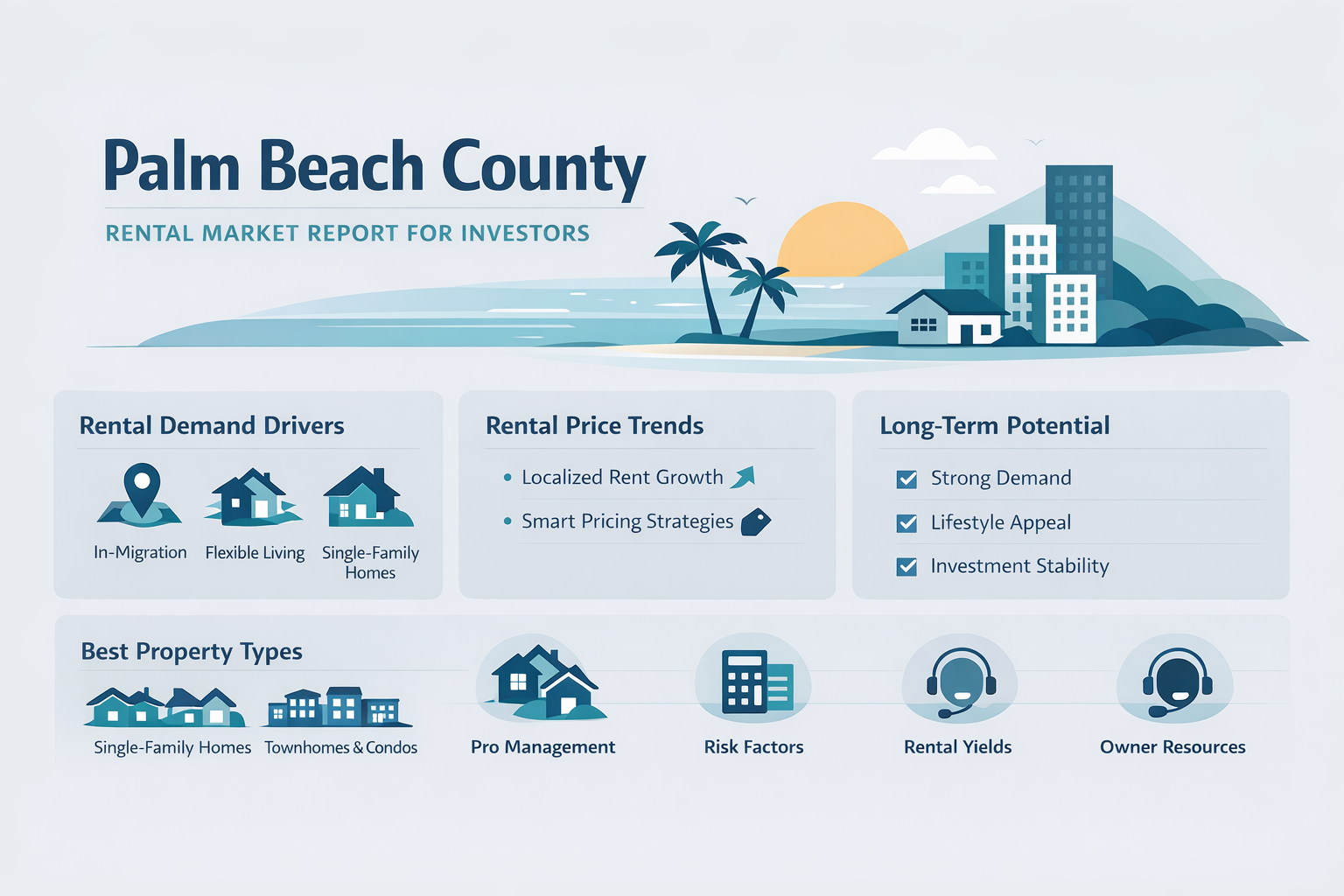
Palm Beach County continues to stand out as one of South Florida’s most closely watched rental markets for real estate investors. From coastal lifestyle demand and high-income relocation patterns to strong long-term household growth and limited desirable housing inventory, the county offers a compelling mix of rental stability, appreciation potential, and operational opportunity. For investors evaluating whether to buy, hold, reposition, or improve a rental asset in this market, understanding how local demand behaves is essential.
This investor-focused market report explains the major forces shaping rental demand in Palm Beach County, where pricing momentum tends to be strongest, what rental property owners should pay attention to when analyzing returns, and why long-term investment fundamentals remain attractive in many submarkets. It also explains how professional management can affect cash flow, leasing speed, maintenance control, and tenant retention.
Why Palm Beach County Remains a Strong Rental Market
Palm Beach County benefits from a broad and diverse renter base. Unlike markets that depend too heavily on one employment sector or one renter profile, this area draws interest from multiple categories of tenants. These include local working professionals, families relocating within Florida, residents arriving from higher-cost states, retirees seeking flexibility before buying, and seasonal or transitional renters who want to live in the area before making a permanent ownership decision.
That diversity matters because it creates a more resilient rental environment. When one segment softens, another often remains active. A landlord with a well-located and properly priced property is not relying on one narrow audience. Instead, the asset may appeal to medical professionals, finance employees, relocating executives, teachers, small business owners, or households simply seeking more space and a better quality of life.
Palm Beach County also benefits from a combination of lifestyle and economic drivers. Access to beaches, golf communities, top lifestyle amenities, major roadways, and employment hubs supports continued housing demand. At the same time, the county includes a range of product types and neighborhood profiles, allowing investors to enter the market at different price points depending on strategy.
Rental Demand Drivers Investors Should Watch
1. Continued In-Migration and Relocation Demand
South Florida has remained a magnet for households seeking warmer weather, tax advantages, and a lifestyle-oriented environment. Palm Beach County often attracts people who want access to premium neighborhoods without being limited to only ultra-luxury coastal inventory. Some move for work. Others arrive for family, schools, or quality of life. Many rent first before buying. That early phase of relocation creates meaningful demand for professionally managed homes and condos.
2. Household Flexibility Favors Renting
Not every resident wants to purchase immediately. Higher mortgage rates, relocation uncertainty, job changes, and the desire to test a neighborhood before committing all favor renting. This is especially relevant for out-of-state arrivals and move-up households who want a smoother transition into Palm Beach County. Investors benefit because that flexibility translates into demand for clean, well-maintained, move-in-ready rental properties.
3. Single-Family Rental Demand Remains Important
One of the most notable characteristics of the county is the continued appeal of single-family homes as rentals. Many residents want yards, garages, additional bedrooms, home office space, and neighborhood environments that traditional apartment inventory cannot always provide. As a result, single-family homes in desirable school zones or commuter-friendly areas often perform well when marketed correctly.
4. Lifestyle-Centered Submarkets Support Premium Rents
Palm Beach County includes communities where renters will pay a premium for convenience, community quality, schools, recreation, or proximity to major destinations. Investors who understand submarket differences can often position a home more effectively by focusing not only on square footage and bedroom count, but also on the lifestyle value of the location.
Hyperlocal Spotlight: Avenir, Palm Beach Gardens
Avenir in Palm Beach Gardens represents one of the most active rental submarkets in Palm Beach County for the specific considerations covered in this guide. Current rental rates in Avenir range from $3,200–4,800/month for single-family and townhome inventory, with demand driven primarily by corporate transferees, dual-income households, and long-term residents seeking stability in a well-maintained community.
Landlords operating in Avenir face the full complexity of Palm Beach Gardens's rental environment: HOA compliance requirements, a tenant pool with above-average income and expectation standards, and seasonal demand variation that rewards landlords who price accurately and market professionally. Atlis currently manages properties throughout Avenir and the broader Palm Beach Gardens submarket, with an average days-to-lease of under 21 days for properly prepared and priced units. Owners in this community who contact Atlis receive a no-obligation rental analysis specific to Avenir market conditions — not a county-wide estimate.
Rental Price Trends Across Palm Beach County
Rental pricing in Palm Beach County is shaped by a familiar but important balance: strong demand meets selective supply. In desirable neighborhoods, quality homes that show well, photograph well, and are priced appropriately tend to generate attention quickly. This does not mean every property can command top-of-market rent. It means the market generally rewards presentation, condition, and strategic pricing.
Investors should view rent trends through a local lens rather than relying on countywide averages alone. A rental in Palm Beach Gardens does not behave the same way as a rental in downtown West Palm Beach, Wellington, Jupiter, or a more workforce-oriented inland submarket. Even within the same ZIP code, newer homes, renovated kitchens, updated bathrooms, garage space, fenced yards, and HOA amenities can materially affect leasing velocity and price.
Another important trend is normalization. In some periods, rents surge rapidly due to sharp supply-demand imbalances. In more stable periods, pricing still holds but tenants become more selective. That distinction matters. A healthy rental market does not require explosive rent growth every year. For long-term investors, a more sustainable environment can actually be beneficial because it reduces volatility and encourages better retention planning.
For owners, the key lesson is simple: do not confuse optimistic pricing with strategic pricing. A home that sits vacant too long may lose more income than an owner gains by reaching for an unrealistic rent target. Vacancy drag, concessions, longer marketing periods, and repeated price reductions can weaken total return. In many cases, accurate pricing at launch is one of the highest-ROI decisions an investor can make.
Rent Growth Trends: Palm Beach County Submarkets 2023–2025
Rent growth in Palm Beach County has not been uniform. Submarkets diverged meaningfully between 2023 and 2025, creating investment opportunities in some areas and softening conditions in others. This data helps owners benchmark their pricing strategy.
Palm Beach Gardens (3BR SFH) 2023–2025
West Palm Beach (3BR SFH) 2023–2025
Boynton Beach (3BR SFH) 2023–2025
Boca Raton (2BR condo) 2023–2025
+9.2%
+6.8%
+5.1%
+7.3%
—
—
—
—
HOA-community demand from corporate transfers
Solid growth, more supply pressure than north county
Affordable tier remains in demand but growth is slower
Luxury condo segment recovered after 2024 softening
Free Service · No Obligation
See Exactly What Your Palm Beach County Rental Should Earn
Get a data-backed rent analysis from Atlis — based on live comparable leases in your specific community. No guesswork, no obligation.
Get My Free Rent Analysis3801 PGA Blvd., Suite 600, Palm Beach Gardens, FL 33410 · (561) 473-3664
What Influences Rent More Than Most Investors Expect
Many owners focus almost entirely on sales comparables when estimating rent, but leasing performance is driven by a different set of variables. Buyers may accept dated finishes if they see upside. Renters are typically more immediate in their decision-making. They compare convenience, cleanliness, functionality, and visual appeal right now.
The following features often have an outsized impact on rental performance:
- Updated kitchens and bathrooms
- Fresh paint and clean flooring
- Washer and dryer availability
- Garage and storage space
- Fenced yard or private outdoor space
- Pet-friendly flexibility where practical
- HOA amenities and neighborhood presentation
- School zone perception
- Commute convenience and proximity to lifestyle centers
- Professional photos and strong listing copy
In other words, rent is not just about the property. It is about the full tenant decision experience.
Best Property Types for Different Investor Goals
Single-Family Homes
Single-family homes remain attractive for investors seeking stable long-term tenancy and broad renter appeal. Families, professionals, and relocation tenants often prefer detached homes because of privacy, extra space, and livability. While maintenance exposure can be higher than in some attached product types, tenant quality and renewal probability can also be strong when the home is in a desirable submarket.
Townhomes
Townhomes can offer an excellent middle ground. They often provide more square footage and functionality than condos, while requiring less exterior maintenance than detached homes. For investors who want a modern rental product with efficient operations, townhomes can be an attractive option, especially in newer communities with strong amenities.
Condominiums
Condos may appeal to investors pursuing lower-maintenance ownership, but they require closer review of association rules, approval processes, lease restrictions, and fee structures. In the right location, condo rentals can perform well, especially for professionals, downsizers, and residents seeking convenience over yard space. However, investors should underwrite carefully because association limitations can directly affect leasing speed and flexibility.
Small Multifamily
Duplexes, triplexes, quads, and small multifamily assets can produce attractive income if managed efficiently. The value in this category often comes from operational improvements, rent repositioning, expense control, and structured tenant management. Investors comfortable with slightly more complexity may find that small multifamily offers a different path to yield than single-asset homes.
Submarket Snapshot: Where Investors Often Focus
Palm Beach Gardens
Palm Beach Gardens is frequently attractive to investors because it offers strong household demographics, desirable communities, quality retail and lifestyle access, and broad appeal to both families and professionals. Properties here often benefit from a more premium market position, particularly when the home is updated and located in a well-regarded neighborhood.
Related internal resource: Palm Beach Gardens Property Management
Jupiter
Jupiter tends to attract renters who value coastal access, community appeal, and a strong quality-of-life profile. Rental demand can remain durable because many households specifically target the area and are willing to pay for location advantages. This can support both retention and premium pricing for well-positioned homes.
Related internal resource: Jupiter Property Management
West Palm Beach
West Palm Beach gives investors a broader mix of opportunities, from urban-style rental demand near downtown and employment centers to surrounding residential neighborhoods with different pricing tiers and tenant profiles. Because of that variety, strategy matters. Some investors target cash-flow efficiency. Others prioritize appreciation and neighborhood transformation potential.
Related internal resource: Florida Property Management
Wellington and Other Family-Oriented Areas
Family-oriented submarkets can perform well because tenants often prioritize schools, home size, and community stability. This tends to favor single-family homes and larger townhomes. Investors who want longer average tenancy may find these areas appealing, particularly if they maintain homes to a standard that encourages renewals.
Rental Yield and Return Expectations
Investors should evaluate Palm Beach County with a balanced mindset. In many parts of the county, this is not purely a high-yield market. It is often a blended-return market, where income, appreciation, tenant quality, and long-term asset positioning all matter. Some neighborhoods may produce lower cap rates than secondary markets, but they can offer stronger downside protection, better tenant demand, and more resilient resale value.
A thoughtful underwriting approach should include:
- Expected monthly rent based on true market comparables
- Realistic vacancy assumptions
- Property taxes and insurance
- HOA or condo association fees where applicable
- Maintenance reserves
- Leasing and turnover costs
- Professional management fees
- Capital expenditure planning
Investors who ignore operating realities often overestimate returns. Investors who underwrite conservatively are better positioned to identify durable opportunities and avoid surprises.
The Role of Professional Property Management in ROI
Professional management is not simply an administrative service. It can materially affect net performance. A strong management system helps reduce avoidable vacancy, improve tenant screening, coordinate maintenance more efficiently, document communication, and keep leasing and renewal workflows organized.
For out-of-state investors especially, management quality may be one of the most important variables in overall investment performance. The right management partner helps owners make better pricing decisions, respond faster to market shifts, and maintain better control over resident experience.
Atlis Property Management provides service information for owners through its residential management and rent collection pages, as well as owner-facing resources available through its website. :contentReference[oaicite:1]{index=1}
Relevant internal resources:
Free 30-Minute Consultation
Questions About Your Palm Beach County Rental? Schedule a Free Call
Jean Taveras answers your specific questions directly — no sales team, no scripts. Pick a time that works for you.
Schedule My Free ConsultationPick a time that works for you · Jean typically responds within 1 business day
Risk Factors Investors Should Not Ignore
Every market has risk, and Palm Beach County is no exception. Strong demand does not eliminate the need for disciplined acquisition and management. Investors should pay close attention to:
- Insurance cost pressure
- Association restrictions or rental caps
- Deferred maintenance on older homes
- Flood zone considerations
- Over-improving a rental beyond what the target tenant will pay for
- Poor screening and preventable delinquency
- Underpricing or overpricing at lease-up
- Weak vendor coordination and slow maintenance response
The best investors are not only optimistic about upside. They are precise about execution risk.
Long-Term Investment Potential in Palm Beach County
For long-term investors, Palm Beach County remains attractive because it combines enduring demand drivers with desirable lifestyle fundamentals. The area is not dependent on one narrow use case. It appeals to full-time residents, part-time residents, relocating families, professionals, retirees, and investors who want exposure to one of Florida’s strongest residential corridors.
Over time, that kind of market depth can support both rental resilience and asset appreciation. Well-located properties in strong condition tend to remain relevant. Investors who buy quality, manage operations well, and maintain a long-term perspective may be positioned to benefit from both income continuity and future value growth.
The most successful strategy is usually not chasing hype. It is buying intentionally, leasing strategically, and operating with discipline.
Landlord Scenario: A Real Palm Beach County Owner's Experience
The situation: A retirement-income landlord owned a 2-bedroom villa in Boynton Beach. She was relying on rental income to supplement retirement but had chronic vacancy issues. The result: signed a tenant without verifying employment, discovering at month 3 that the tenant had been laid off and couldn't pay rent.
What changed: After engaging Atlis Property Management, the team implemented Atlis's income verification protocol requiring 2 months of pay stubs plus employer verification call. The property was brought into compliance with current market standards and operational best practices within 30 days of onboarding.
The outcome: The owner placed tenants with verified, stable income in every subsequent tenancy — no income-related payment issues in 22 months. The management fee paid for itself within the first lease term, and the owner has since retained Atlis for two additional properties in her portfolio.
Investor Action Plan
If you are evaluating rental property opportunities in Palm Beach County, begin with the fundamentals:
- Choose the submarket before choosing the property.
- Analyze renter demand for that exact product type.
- Estimate true market rent using current comparable inventory.
- Underwrite all operating costs conservatively.
- Review HOA, condo, and leasing restrictions carefully.
- Identify the ideal resident profile before making renovations.
- Build a retention and maintenance strategy from day one.
- Use professional management if scale, distance, or time constraints justify it.
Investors who take that structured approach typically make better acquisitions and achieve more consistent long-term performance.
Conclusion
Palm Beach County continues to offer meaningful opportunity for rental investors who understand how local demand, pricing, product type, and neighborhood quality interact. This is a market where details matter. Presentation matters. Management matters. Location absolutely matters.
For investors who want a market with broad tenant appeal, long-term desirability, and a strong quality-of-life foundation, Palm Beach County deserves serious consideration. Whether your goal is stable cash flow, long-term appreciation, or portfolio diversification within South Florida, a well-selected and well-managed rental asset in this county can be a powerful long-term holding.
To explore Atlis Property Management’s owner resources, services, and contact information, visit: Contact Atlis Property Management. :contentReference[oaicite:2]{index=2}
Frequently Asked Questions
Is Palm Beach County a good place to buy rental property?
It can be an attractive market for investors who value long-term demand, lifestyle-driven migration, and strong neighborhood quality. The best opportunities depend on submarket, price point, and operating strategy.
What type of rental property performs best in Palm Beach County?
Single-family homes, townhomes, condos, and small multifamily properties can all perform well, but each serves a different renter profile and investment objective.
Are single-family homes still in demand?
Yes. Many tenants continue to seek detached homes for privacy, storage, yard space, and family functionality.
Do HOA communities help or hurt rental performance?
They can do both. Strong communities may support rent and tenant appeal, but investors must review lease restrictions, application procedures, and fees before buying.
Should investors focus on appreciation or cash flow in Palm Beach County?
Many investors pursue a balanced strategy. Some submarkets are more appreciation-oriented, while others may offer better income efficiency.
How important is professional property management?
It can be very important, particularly for out-of-state owners or investors who want more structured leasing, maintenance coordination, rent collection, and tenant communication.
What is the biggest mistake rental investors make here?
A common mistake is relying on overly optimistic rent expectations without accounting for condition, competition, vacancy exposure, or turnover costs.
Can investors manage properties remotely in Palm Beach County?
Yes, but remote ownership generally works best when systems, vendors, communication, and property oversight are handled professionally.
What should owners improve before listing a rental?
Focus first on cleanliness, paint, flooring condition, lighting, curb appeal, landscaping, and any visible deferred maintenance that may reduce perceived value.
Where can I learn more about AtlisPM services?
You can review service and owner resources through the AtlisPM website, including the residential management page, rent collection page, homes-for-rent page, and sitemap.