The 2026 West Palm Beach Real Estate Capital Stack Guide | Atlis PM
A Strategic Briefing for Developers, CPAs, and Institutional Partners
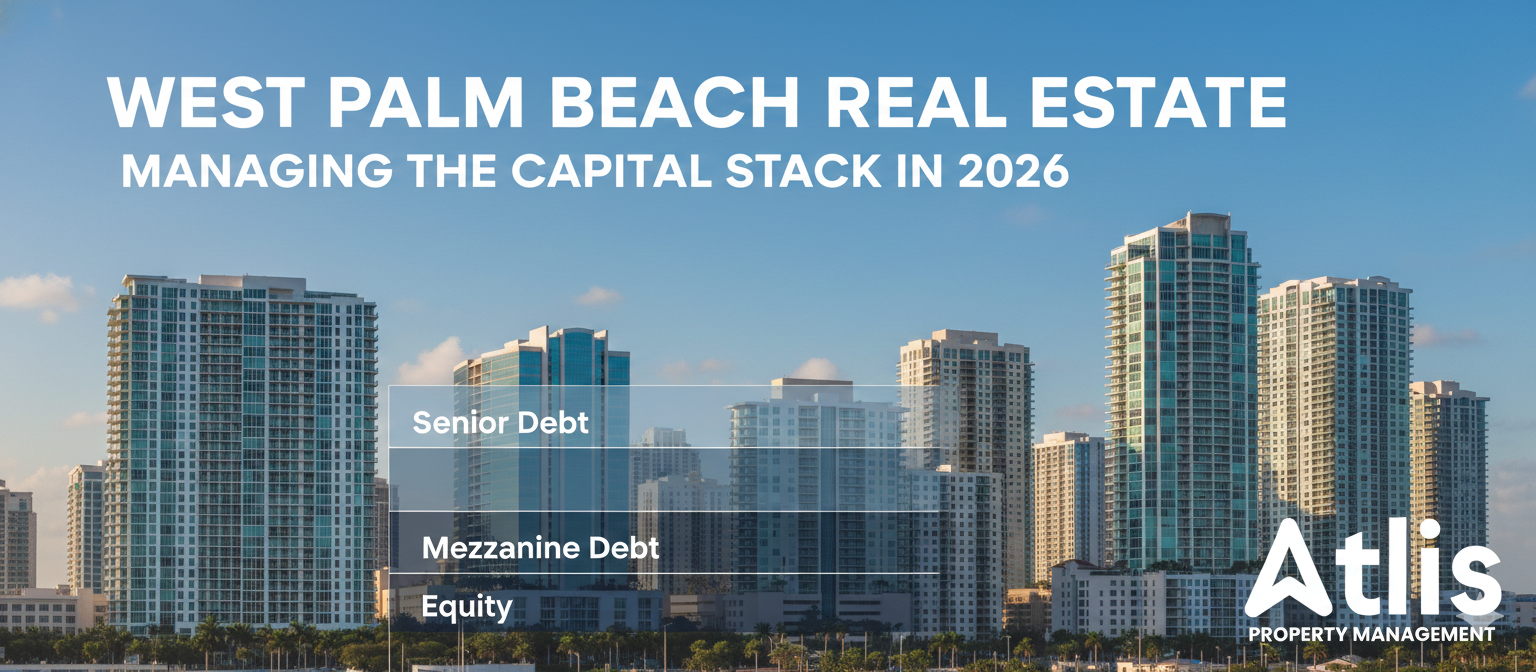
As "Wall Street South" matures, the migration of high-net-worth capital into Palm Beach County has professionalized the industry. Legacy holdings are moving into more complex systems that allow for better liquidity and risk management. For developers and CPAs, understanding how Family-Owned Real Estate interacts with these new institutional models is now a requirement for any portfolio exceeding 65 units.
The Evolution of Family-Owned Real Estate
For decades, the West Palm Beach market was defined by Family-Owned Real Estate. These were "buy and hold" assets often managed with a long-term, multi-generational view. However, in 2026, many of these owners are facing a crossroads. Rising insurance premiums, higher labor costs for maintenance, and the complexity of new digital management systems are making "mom and pop" operations less viable.
For a real estate CPA, this shift represents a massive opportunity to advise on 1031 exchanges or to help families move their assets into Private Equity Funds. We are seeing a distinct trend where families are pooling their properties into private syndications to achieve the same scale as a REIT (Real Estate Investment Trust). This professionalization allows legacy owners to maintain their footprint in the Florida market while reducing the operational friction of day-to-day management.
Qualified Opportunity Funds: The 2026 Recognition Deadline
One of the most critical tools for developers in West Palm Beach is the Qualified Opportunity Zone (QOZ) program. While this program has provided years of tax-deferred growth, 2026 is the "Judgment Day" for the original tax benefits established under the Tax Cuts and Jobs Act of 2017.
Federal and State Compliance Alerts
Under 26 U.S. Code § 1400Z–2, investors who reinvested capital gains into a Qualified Opportunity Fund (QOF) must recognize those deferred gains on December 31, 2026. This means the tax bill for those original gains is coming due in April 2027.
The OBBB Extension: The One Big Beautiful Bill (OBBB), signed in 2025, has introduced "OZ 2.0." While it does not change the 2026 recognition date for old gains, it makes the QOZ program permanent with new rolling 10-year designations. Governors are set to designate new zones starting July 1, 2026, which will take effect in 2027.
Hyperlocal Spotlight: Abacoa, Jupiter
Abacoa in Jupiter represents one of the most active rental submarkets in Palm Beach County for the specific considerations covered in this guide. Current rental rates in Abacoa range from $3,400–4,200/month for single-family and townhome inventory, with demand driven primarily by corporate transferees, dual-income households, and long-term residents seeking stability in a well-maintained community.
Landlords operating in Abacoa face the full complexity of Jupiter's rental environment: HOA compliance requirements, a tenant pool with above-average income and expectation standards, and seasonal demand variation that rewards landlords who price accurately and market professionally. Atlis currently manages properties throughout Abacoa and the broader Jupiter submarket, with an average days-to-lease of under 21 days for properly prepared and priced units. Owners in this community who contact Atlis receive a no-obligation rental analysis specific to Abacoa market conditions — not a county-wide estimate.
Free Service · No Obligation
Free West Palm Beach Rental Analysis From Atlis
See what your West Palm Beach rental should command in today's market — with live comparable data from Atlis's active portfolio.
Get My Free Rent Analysis3801 PGA Blvd., Suite 600, Palm Beach Gardens, FL 33410 · (561) 473-3664
Private Equity and REIT Integration: The Exit Strategy
There is a significant consolidation happening in the Palm Beach County market. Private Equity Funds are no longer just looking for "distressed" assets; they are seeking high-quality, value-add apartment buildings with durable cash flows. For a local developer, the ultimate exit strategy is often a sale to a national REIT.
REITs have remained active in the Hospitality and luxury residential sectors because they offer a hedge against inflation. In 2026, many residential REITs have focused their "dry powder" on West Palm Beach because of the "sticky" demographic of high-earning renters. This "Flight to Quality" means that assets managed with institutional-grade reporting are fetching much higher multiples in the secondary market.
Lease Renewal Economics: The Cost of Turnover vs. Retention in Palm Beach County
Every lease renewal averted is a turnover event. In Palm Beach County, the full cost of tenant turnover — vacancy, leasing fees, make-ready, and re-leasing time — consistently exceeds what landlords budget. This comparison shows the true retention premium.
Rent increase accepted at renewal (vs. re-listing)
Avg. make-ready cost after quality tenant
Avg. vacancy days during turnover (Atlis-managed)
Net annual benefit of one retained renewal (vs. turnover)
+$100–$200/mo
$900–$1,800
16 days
$3,100–$6,400
+$200–$350/mo via re-listing
FL avg: $600–$1,200
FL professional mgmt avg: 26 days
FL market est: $2,000–$4,500
Re-listing achieves higher rent — but turnover cost offsets it
Normal wear; vs. $3,200–$6,500 after a difficult tenancy
Speed of re-leasing determines the true cost of turnover
Retention nearly always wins the financial comparison
Hospitality and the "Hotelization" of Housing
The Hospitality sector in West Palm Beach is undergoing a radical shift. The line between a hotel and an apartment is fading. Developers are now creating "Residential-Hybrid" projects that offer hotel-like amenities and concierge services to long-term renters to drive higher per-square-foot premiums.
However, this hybrid model comes with increased regulatory scrutiny. Developers must navigate Florida Statutes Chapter 509, which governs public lodging establishments, while ensuring they do not trigger local zoning violations in residential districts. Private Equity Funds are particularly attracted to this model because it diversifies income through amenity fees and short-term stay options during peak Florida seasons.
Free Operational Audit
Get a Free Operational Audit of Your Palm Beach County Rental
We review rent pricing, vacancy patterns, maintenance spend, and management gaps — then give you a clear action plan at no cost.
Landlord Scenario: A Real Palm Beach County Owner's Experience
The situation: A vacation-home owner owned a 3-bedroom pool home in Jonathan's Landing, Jupiter. She rented the property seasonally but struggled with off-season vacancy. The result: priced the unit $400 above market based on her mortgage payment, resulting in 47 days of vacancy before she reduced the rent.
What changed: After engaging Atlis Property Management, the team re-priced the unit using Atlis's comparable analysis. The property was brought into compliance with current market standards and operational best practices within 30 days of onboarding.
The outcome: The owner leased within 18 days at $3,050/month — $200 more than her original occupied rent — and the vacancy gap cost was never repeated. The management fee paid for itself within the first lease term, and the owner has since retained Atlis for two additional properties in her portfolio.
2026 Compliance and Tax Updates: A Guide for CPAs
1. The Corporate Transparency Act (CTA) Expansion
As of March 1, 2026, FinCEN has implemented the "Residential Real Estate Rule." This requires reporting for non-financed transfers of residential property (1-4 units) to legal entities like LLCs or trusts. This is a massive change for Family-Owned Real Estate owners who traditionally used LLCs for privacy. Failure to report can result in civil fines of $500 per day.
2. Florida HJR 203 and Property Tax Relief
Florida lawmakers are currently phasing in changes to ad valorem taxation. For developers, the "Live Local Act" (HB 7073) remains the most powerful tool for 2026. For developments that dedicate at least 40% of their units to workforce or attainable housing, there are now administrative pathways to bypass local height and density restrictions, provided the developer adheres to the new 50-year affordability covenant.
3. 100% Bonus Depreciation Reinstated
The OBBB Act of 2025 permanently reinstated the 100% bonus depreciation under Section 168(k) for qualified property acquired and placed in service after January 19, 2025. This allows for the immediate expensing of major capital improvements, such as HVAC systems, roofing, and structural resilience upgrades necessitated by Florida's evolving insurance requirements.
Operational Roadmap: Scaling to 65+ Units
Whether you are a developer completing a new project or an investor aggregating scattered-site properties, the biggest threat to your NOI is "Administrative Drag." Professionalizing operations is the only way to remain attractive to institutional buyers.
Atlis Property Management specializes in bridging the gap between legacy family values and the high-tech requirements of fund-backed assets. Our approach focuses on:
- Institutional Reporting: Delivering the clear, audited financials that REITs and CPAs require for due diligence.
- Operational Audits: We perform annual reviews to ensure that Operating Expense Ratios (OER) are optimized and that vendor contracts are re-bid to reflect 2026 labor rates.