The 2026 PGA National Property Management & Investor Guide | Atlis Property Management
The 2026 PGA National Property Management & Investor Guide
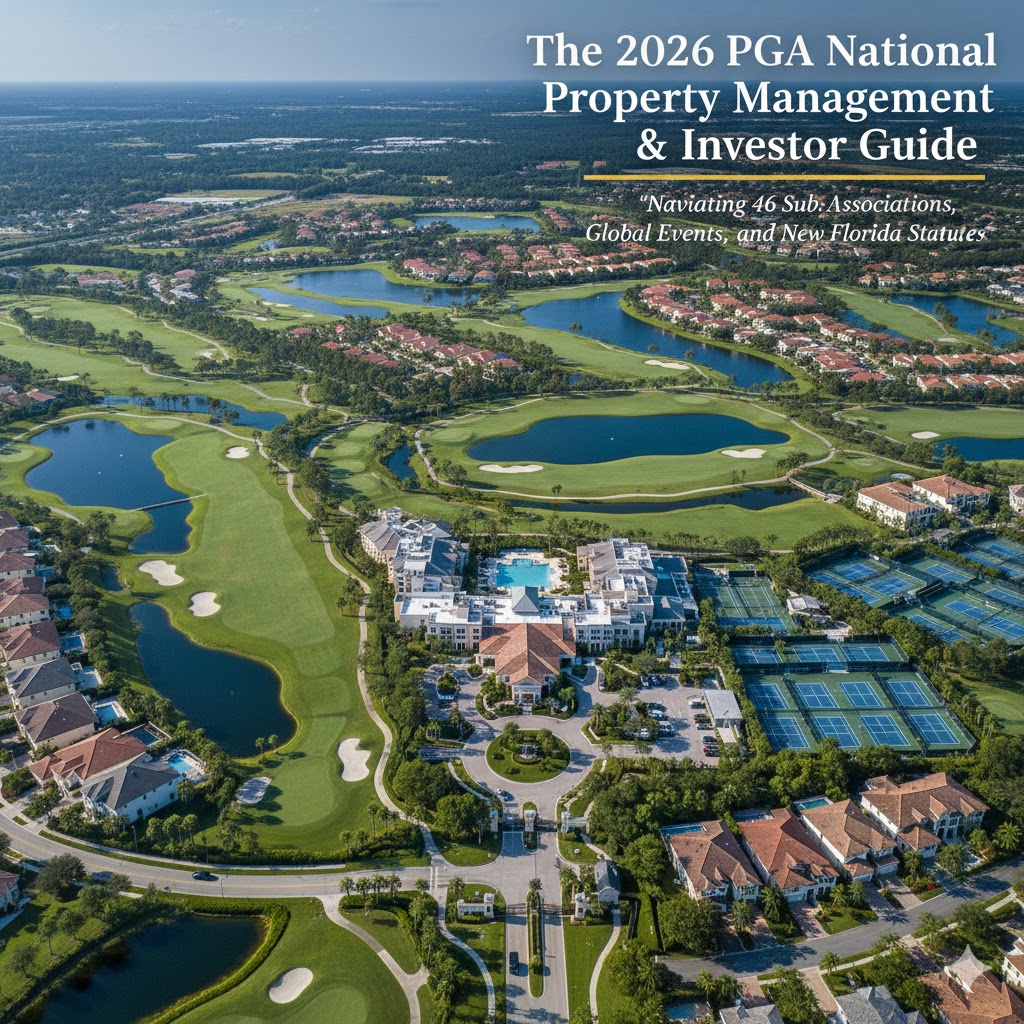
PGA National remains one of Palm Beach Gardens’ most recognizable master-planned communities. In 2026, successful ownership here is driven by disciplined compliance across layered HOA governance, proactive maintenance, and rental strategy aligned with sub-association rules.
The State of PGA National Real Estate in 2026
PGA National, an iconic master-planned community in Palm Beach Gardens, continues to attract golf enthusiasts, relocating professionals, and affluent families. Its global recognition—strengthened by high-visibility tournament branding—contributes to durable market demand and long-term brand value.
In 2026, effective ownership and leasing in PGA National is rarely a “single-HOA” experience. It is typically a layered governance structure consisting of a Master Association plus a large number of sub-associations. Each sub-community may maintain its own covenants, architectural review processes, and rental rules that can materially affect leasing timelines, tenant qualification, and permitted lease terms.
The 2026 market shows a pronounced preference for fully updated homes with strong amenity value. Properties that are updated, well-furnished (when leased seasonally), and professionally maintained tend to outperform in both tenant quality and pricing outcomes. Conversely, owners who underestimate association rules, approval timelines, or upkeep standards often encounter avoidable delays and enforcement issues.
1. The 2026 Rental Market & Sub-Community Dynamics
PGA National’s housing inventory spans condos and villas through single-family homes and luxury estates. As a result, rental demand is multi-sourced in 2026: corporate relocations, seasonal residents seeking golf access, and local families who prioritize schools, safety, and community amenities.
Projected 2026 Rental Benchmarks by Sub-Community Type
| Sub-Community Type | Monthly Rent (Annual) | Monthly Rent (Seasonal) | Key Features |
|---|---|---|---|
| Condos / Villas (e.g., Barclay Club, Ryder Cup Villas) | $3,000 – $5,500 | $6,000 – $10,000 | Maintenance-lite living, access to community pools, strong fit for seasonal occupancy. |
| Single-Family Homes (e.g., Grand Cay, Marlwood Estates) | $6,000 – $12,000 | $12,000 – $25,000 | Private pools (often), larger lots, family-oriented layouts, stronger long-term demand. |
| Luxury Estates (e.g., Champion’s Club, Eagleton Lakes) | $13,000 – $25,000+ | $25,000 – $50,000+ | Custom builds, golf frontage, premium finishes, and concierge-level expectations. |
Note: Seasonal pricing commonly commands a 2–3x premium vs. annual rates and often requires premium furnishings and higher-touch services. Additionally, leases under six months may trigger local tax obligations (including the Palm Beach County Tourist Development Tax, when applicable). Owners should confirm applicability with a qualified tax professional and ensure their lease structure is compliant.
The Master Association vs. Sub-Associations
A frequent source of confusion is assuming the Master Association controls all rental rules. In practice, the Master Association typically governs key common elements (such as major roadways, shared amenities, or overarching standards), while sub-associations may establish highly specific requirements affecting exterior appearance, lot/landscaping expectations, and the leasing framework (minimum term, frequency limits, approvals, etc.).
Hyperlocal Spotlight: Northwood Shores, West Palm Beach
Northwood Shores in West Palm Beach represents one of the most active rental submarkets in Palm Beach County for the specific considerations covered in this guide. Current rental rates in Northwood Shores range from $2,400–3,400/month for single-family and townhome inventory, with demand driven primarily by corporate transferees, dual-income households, and long-term residents seeking stability in a well-maintained community.
Landlords operating in Northwood Shores face the full complexity of West Palm Beach's rental environment: HOA compliance requirements, a tenant pool with above-average income and expectation standards, and seasonal demand variation that rewards landlords who price accurately and market professionally. Atlis currently manages properties throughout Northwood Shores and the broader West Palm Beach submarket, with an average days-to-lease of under 21 days for properly prepared and priced units. Owners in this community who contact Atlis receive a no-obligation rental analysis specific to Northwood Shores market conditions — not a county-wide estimate.
2. Navigating the Layered Leasing Restrictions
Leasing restrictions are often the largest operational risk for an owner unfamiliar with PGA National’s sub-community variation. The restrictions can change by enclave and may be amended over time. The cost of getting this wrong is typically measured in lost time, lost revenue, and in some cases enforcement action.
Typical 2026 Leasing Protocols
- Minimum lease terms: Some communities allow shorter terms, but many require 3-month or 6-month minimums. Certain enclaves require 12-month terms. Confirm the exact minimum term prior to advertising.
- Frequency limits: A common standard is no more than two (2) leases per calendar year, with some communities pairing this with longer minimum terms to reduce turnover.
- Tenant approval: Many sub-associations require background checks, credit review, and sometimes interviews. Processing timelines can range from approximately 15–30 days depending on the association.
- Application fees: It is common to see separate fees at different layers (Master Association and sub-association). Fees are often non-refundable and may be assessed per applicant or per lease cycle.
Free Service · No Obligation
See Exactly What Your Palm Beach County Rental Should Earn
Get a data-backed rent analysis from Atlis — based on live comparable leases in your specific community. No guesswork, no obligation.
Get My Free Rent Analysis3801 PGA Blvd., Suite 600, Palm Beach Gardens, FL 33410 · (561) 473-3664
Jupiter vs. West Palm Beach Rental Market: Key Metrics Compared
Landlords choosing between Jupiter and West Palm Beach as investment markets face meaningfully different operating environments. Understanding the data behind each submarket helps owners set accurate expectations for returns, vacancy, and tenant quality.
Average days to lease
Tenant income-to-rent ratio
HOA-governed rental rate
Year-over-year rent growth (2024–2025)
20 days
3.6×
74%
+5.8%
26 days
3.0×
52%
+3.9%
Jupiter's tighter inventory drives faster absorption
Jupiter applicants are proportionally higher income
Jupiter HOA compliance burden is significantly higher
Jupiter outpaces county average on appreciation
3. 2026 Legal Updates: FS 720.303, HB 1021, and Flood Disclosure
The legislative environment impacting Florida HOAs and residential leasing continues to evolve. Owners in association-governed communities should treat legal compliance as a core operating requirement, not an administrative afterthought.
Digital Transparency and Records Access (FS 720.303)
Larger associations increasingly provide secure portals for records access, which can materially improve visibility for remote owners. When properly administered, an online records portal can provide timely access to vendor contracts, meeting agendas, meeting minutes, budgets, financial statements, and reserve information—each of which can affect operating costs and assessment risk.
Fining Process and Due Process Controls (HB 1021 – “HOA Reform”)
2026 rule changes have emphasized procedural safeguards and cure opportunities prior to fines being imposed. For owners, the practical impact is that faster communication and faster response to notices can reduce escalation risk. However, cure windows are only valuable if notices are actually received and acted on promptly—which is why professional mail monitoring and property manager notifications matter for out-of-state owners.
Mandatory Flood Disclosure for Florida Leases
Florida leases now commonly require flood disclosure language. The operational implication is simple: your lease package must be updated, your files must be consistent, and your tenant intake process must ensure signatures are collected and retained. If you rely on older templates, you may be creating avoidable risk.
4. Maintenance: Upholding PGA National’s Aesthetic Standards
PGA National’s reputation is tied to appearance, consistency, and enforced standards. Architectural Review Boards and compliance committees often maintain strict expectations regarding exterior condition, visible cleanliness, landscaping, and approved modifications. For remote owners, small issues can become violations if not tracked and resolved quickly.
Critical 2026 Maintenance Priorities
- Roof and driveway cleanliness: Humidity, algae, and mildew are common in South Florida. Annual soft-wash roof care and routine driveway cleaning can reduce violation risk and protect surfaces.
- Landscape integrity: Even where some landscaping is association-maintained, owners may retain responsibility for private yard areas, shrubs, plant replacement, and irrigation functionality.
- Exterior paint compliance: Many HOAs enforce approved palettes and repaint schedules. Unapproved color changes or deferred repainting can lead to enforcement action.
- HVAC preventative maintenance: Bi-annual service is commonly prudent in South Florida’s climate to reduce drain line clogs, humidity issues, and mold risk. Smart thermostats can help monitor indoor humidity remotely.
Free 30-Minute Consultation
Schedule a Free Consultation with Jean Taveras
Get straight answers from a licensed Florida broker who manages residential properties across Palm Beach County. No sales pitch — just honest, expert guidance on your specific situation.
Schedule My Free ConsultationPick a time that works for you · Jean typically responds within 1 business day
5. Financial Optimization: Property Taxes & Insurance
High-value properties in association-governed communities require disciplined financial planning. In 2026, two categories commonly drive outsized volatility: property taxes for non-homesteaded assets and insurance coverage gaps that leave owners exposed to assessments or storm-related losses.
Tax Mitigation Concepts for 2026 (Informational)
- Non-homestead tax exposure: Investment properties generally lack homestead protections and can experience higher annual increases compared to owner-occupied properties.
- Cost segregation studies: For qualifying owners, a cost segregation study may accelerate depreciation on certain components. This is a technical strategy requiring qualified tax guidance.
Insurance Considerations for 2026
- Loss assessment coverage: Condo and HOA-governed assets may face special assessments after large losses or major capital events. Robust loss assessment coverage can reduce personal exposure.
- Wind mitigation: A wind mitigation inspection can document features that may improve premium pricing (e.g., opening protection, roof attachments, secondary water barrier), subject to insurer underwriting.
Landlord Scenario: A Real Palm Beach County Owner's Experience
The situation: A first-time landlord owned a 2-bedroom condo in Abacoa, Jupiter. She converted her primary residence into a rental after relocating for work. The result: allowed a tenant to make unauthorized modifications — painting three rooms and installing a pet door — which cost $2,900 to restore at move-out, none of which was recoverable without a prohibition clause.
What changed: After engaging Atlis Property Management, the team added Atlis's alteration prohibition addendum to all future leases. The property was brought into compliance with current market standards and operational best practices within 30 days of onboarding.
The outcome: The owner enforced a chargeback for $1,600 in unauthorized alterations at the following move-out, fully supported by the lease language. The management fee paid for itself within the first lease term, and the owner has since retained Atlis for two additional properties in her portfolio.
6. The Strategic Advantage of Professional Management
In a community with layered governance, strict appearance standards, and variable rental rules, professional management is not simply a convenience. For many owners, it is an asset-protection mechanism designed to reduce vacancy exposure, minimize compliance risk, and maintain stable operating performance.
How Atlis Property Management Supports PGA National Owners
- Multi-HOA compliance: We coordinate requirements between the Master Association and the applicable sub-association, including applications, approvals, and documented processes.
- Proactive maintenance oversight: We use vetted local vendors and structured workflows to keep properties aligned with community standards and reduce reactive costs.
- Tenant screening and retention: Rigorous screening helps reduce turnover risk—particularly important where rental frequency is limited.
- Financial accountability: Clear reporting, tracking of HOA dues, and structured documentation aligned to operating best practices.
Summary Table for Quick Reference: PGA National (2026)
| Requirement | Details & 2026 Operating Notes |
|---|---|
| Minimum Lease Term | Varies by sub-association (often 3–6 months; some allow shorter; some require 12 months). Verify governing documents for your address. |
| Lease Frequency | Often limited (commonly up to 2 leases per year), depending on sub-association rules and minimum term requirements. |
| Tenant Approval | Frequently required at sub-association level (and sometimes Master level). Approval timelines can materially affect move-in scheduling. |
| Digital HOA Portal | Many associations provide online access to records, financials, minutes, and vendor information—particularly valuable for remote owners. |
| Flood Disclosure | Lease packages should include required flood disclosure language and signed acknowledgments, retained in the tenant file. |
| Fining Process | Due process and cure opportunities may apply before fines are imposed. Timely notice handling remains essential for out-of-state owners. |
| Non-Homestead Taxes | Investment properties may experience higher annual increases vs. homesteaded properties. Consider tax planning strategies with a qualified professional. |
| Maintenance Standard | High. Focus areas include roof/driveway cleanliness, landscaping integrity, exterior paint compliance, and HVAC preventative maintenance. |
Secure Your PGA National Investment
PGA National is a premier community that rewards disciplined ownership. If you want to reduce compliance risk, protect property condition, and position your asset for stronger long-term performance, professional management can provide the operating structure required—especially for remote owners.
Next Step: If you would like, we can provide a “PGA National Tenant Welcome Packet” template that clearly outlines community rules, amenity guidance, and key contacts to improve compliance and tenant experience.