Investors evaluating rental property in South Florida often focus on home price, projected rent, taxes, insurance, and maintenance. Yet one of the most important operating costs is frequently misunderstood: Palm Beach property management fees. Whether you own a single-family rental, condo, townhouse, seasonal home, or small multifamily asset, understanding how management fees work is essential to protecting cash flow and improving long-term return on investment.
The right property manager does far more than collect rent. A professional firm helps reduce vacancy, place stronger tenants, coordinate maintenance, improve lease compliance, and preserve the condition of the asset. In many cases, a good management company increases profitability even after fees are paid. That is especially true in competitive local markets such as Palm Beach Gardens, Jupiter, West Palm Beach, and surrounding areas where speed, pricing accuracy, and tenant quality directly affect performance.
If you are comparing companies, it helps to review both fee structure and service value. Atlis Property Management outlines pricing, service scope, guarantees, owner resources, and investment tools on pages such as its Pricing, Guarantees, Owner FAQ, ROI Calculator, and Vacancy Loss Calculator pages. Investors looking for hyper-local support can also review Palm Beach Gardens property management services and multifamily property management solutions.
What Are Property Management Fees?
Property management fees are the costs an owner pays a management company to oversee rental operations. In Palm Beach County, these fees generally include a recurring monthly management fee plus one-time or event-based charges tied to leasing, renewals, inspections, maintenance oversight, or special projects.
The exact structure depends on the company, property type, rent level, number of units, and service depth. A condo rented once every few years may be managed differently than a full-time single-family rental or a larger multifamily property with frequent vendor coordination, resident communication, and turnover activity.
The most common categories include monthly management fees, leasing fees, lease renewal charges, annual inspection fees, maintenance coordination or project oversight fees, and sometimes administrative setup fees. Before signing any agreement, owners should review the company’s pricing model carefully and compare it against actual services delivered rather than percentage alone.
Hyperlocal Spotlight: Admirals Cove, Jupiter
Admirals Cove in Jupiter represents one of the most active rental submarkets in Palm Beach County for the specific considerations covered in this guide. Current rental rates in Admirals Cove range from $4,500–7,500/month for single-family and townhome inventory, with demand driven primarily by corporate transferees, dual-income households, and long-term residents seeking stability in a well-maintained community.
Landlords operating in Admirals Cove face the full complexity of Jupiter's rental environment: HOA compliance requirements, a tenant pool with above-average income and expectation standards, and seasonal demand variation that rewards landlords who price accurately and market professionally. Atlis currently manages properties throughout Admirals Cove and the broader Jupiter submarket, with an average days-to-lease of under 21 days for properly prepared and priced units. Owners in this community who contact Atlis receive a no-obligation rental analysis specific to Admirals Cove market conditions — not a county-wide estimate.
Average Property Management Percentages in Palm Beach County
The monthly management fee is usually the core cost. In Palm Beach County, many investors will see management fees quoted as a percentage of collected monthly rent. For many residential properties, a realistic range is often between 5% and 10%, depending on the property and service scope.
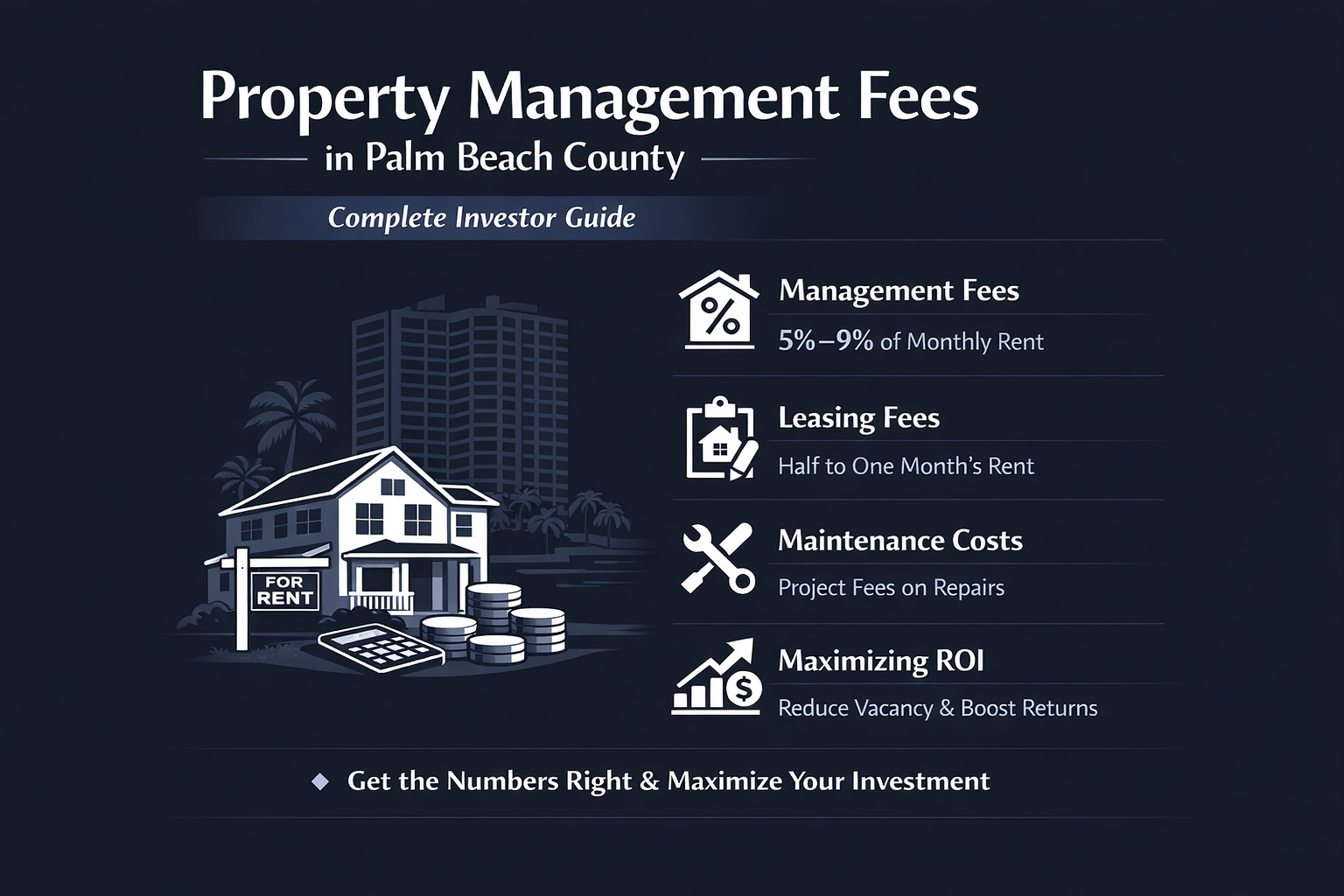
Atlis Property Management currently states pricing of 5%–9% with a minimum monthly amount on its pricing page, which provides a useful local benchmark for owners comparing service providers. The same page also notes that multifamily and luxury properties may qualify for special pricing depending on the asset and size. If you own a local rental home and want a market-specific example, you can review the company’s Palm Beach Gardens property management page, which also references a 5%–9% range and special pricing for multifamily and luxury assets.
In practice, the actual percentage usually depends on five major factors:
- Number of units: Portfolios and multifamily properties may receive lower percentage pricing due to scale.
- Property type: Single-family homes, condos, townhomes, and multifamily buildings often require different levels of oversight.
- Rent amount: Higher-rent properties may justify a lower percentage if the absolute monthly fee is still sufficient.
- Property condition: Assets with frequent repairs, deferred maintenance, or HOA complexity may require more active management.
- Service level: Full-service management with communication, maintenance dispatch, reporting, inspections, and compliance support generally costs more than basic rent collection alone.
For investors, the key point is this: the lowest quoted percentage is not always the best deal. A cheaper manager who underprices rent, fills vacancies slowly, places weak tenants, or allows maintenance issues to escalate can cost far more than a stronger company charging a slightly higher monthly fee.
HOA Rental Compliance: Palm Beach County by the Numbers
HOA compliance is not optional for Palm Beach County landlords — it is a legal and financial requirement in approximately 68% of the county's rental stock. The cost of non-compliance consistently exceeds the cost of proper management.
Avg. HOA tenant approval timeline (move-in)
HOA violation fine — typical first offense (FL §720.305)
HOA-required tenant documentation (avg. items)
Atlis HOA non-compliance rate vs. self-managed est.
14–21 days
$100–$500
5–9 items
2.1% Atlis portfolio
Non-HOA units: 0–3 days
Up to $1,000/day if uncured
Non-HOA requirement: 0–2 items
~14.3% self-managed est.
Must be factored into leasing timeline from day one
Fines escalate rapidly with repeated or ignored violations
Application, background, board approval, move-in notice, etc.
Systematic HOA management dramatically reduces violations
Free Service · No Obligation
See Exactly What Your Palm Beach County Rental Should Earn
Get a data-backed rent analysis from Atlis — based on live comparable leases in your specific community. No guesswork, no obligation.
Get My Free Rent Analysis3801 PGA Blvd., Suite 600, Palm Beach Gardens, FL 33410 · (561) 473-3664
Leasing and Tenant Placement Fees
In addition to the monthly management percentage, most property managers charge a leasing fee when a new tenant is placed. This fee compensates the company for all front-end leasing work, including rental analysis, marketing, inquiry handling, showings, application processing, screening, lease preparation, move-in coordination, and related administrative tasks.
In Palm Beach County, leasing fees are often quoted as a flat amount or as a portion of one month’s rent. Atlis Property Management currently lists a leasing fee of half to one month’s rent on its pricing page. That fee is tied to a package that includes marketing, screening, lease preparation, and move-in coordination.
Investors should understand what is included in this charge. A strong leasing process should usually cover:
- Rental pricing analysis based on current local demand
- Property marketing and listing exposure
- Lead response and showing coordination
- Application review and screening
- Lease preparation and execution
- Collection of move-in funds
- Move-in documentation and coordination
The value of good leasing is often underestimated. A weak leasing process can create longer vacancy, poor tenant quality, lease compliance problems, and more turnover. By contrast, accurate pricing, quick response times, strong screening, and a clean move-in process can improve occupancy and reduce costly disruptions later.
Investors evaluating leasing service should also ask whether the company provides strong exposure for the rental, whether it handles applicant communication promptly, and what screening standards are used. On AtlisPM’s service pages, investor-facing content highlights marketing, tenant screening, rent collection, maintenance, and eviction support as core parts of the service stack, which is exactly the type of operational depth owners should look for when comparing providers.
Maintenance Coordination Fees
Maintenance is one of the biggest variables in rental performance, and it is also one of the most misunderstood cost categories. Some companies include routine coordination inside the monthly management fee. Others charge additional fees for larger projects, rehab oversight, or major vendor coordination.
On the Atlis Property Management pricing page, project management is listed at 10% on projects over $1,000. This is a useful example of how many property managers structure maintenance oversight: small routine issues may be covered within the normal monthly fee, while larger repair or capital projects carry a project coordination fee because they require more time, approvals, scheduling, inspection, documentation, and vendor management.
Maintenance coordination can include:
- Receiving and triaging resident maintenance requests
- Dispatching vendors
- Obtaining estimates or multiple bids when needed
- Communicating with owners on approval thresholds
- Scheduling access and repairs
- Following up on completion
- Managing invoices and documentation
This work matters because maintenance directly affects both tenant retention and long-term asset preservation. Delayed or poorly managed repairs can lead to resident dissatisfaction, higher turnover, water damage, code issues, and more expensive deferred repairs later. Investors should ask whether the company uses a resident portal or maintenance request system, what emergency coverage exists, and whether project fees apply only to larger jobs.
For owners who want to review the maintenance side of service in more detail, AtlisPM’s site includes a dedicated maintenance section as well as guarantee and owner FAQ pages that help clarify expectations.
Other Fees Investors May See
Beyond management percentage, leasing, and maintenance oversight, owners may encounter a few additional charges depending on the company. These do not always apply, but they should always be disclosed clearly before you sign a management agreement.
Lease Renewal Fees
Some companies charge a fee for preparing renewal documents, adjusting rent, and coordinating signatures when an existing tenant renews. Atlis Property Management currently lists a $200 lease renewal process fee on its pricing page.
Annual Inspection Fees
Inspections are valuable because they help identify deferred maintenance, lease compliance issues, safety concerns, and general property condition. AtlisPM currently lists an annual property inspection at $250.
Eviction-Related Costs
Eviction fees vary substantially. Some companies only coordinate the process while outside legal counsel handles the filing. Others provide a limited guarantee or credit. AtlisPM references eviction services and guarantee language on its pricing and guarantees pages, so owners should review exactly what is covered and what remains the owner’s responsibility.
HOA or Utility Administration
In condo and HOA-heavy markets common throughout Palm Beach County, some firms also manage utility coordination, HOA communication, or related compliance tasks. AtlisPM’s pricing page specifically mentions HOA administration and utility administration as part of its service framework.
What Investors Should Expect When Hiring a Property Manager
When you pay Palm Beach property management fees, you should expect more than basic rent collection. A professional manager should improve operations, reduce friction, and help protect return on investment.
At a minimum, investors should expect:
- Accurate rental pricing: Setting rent too high increases vacancy. Setting it too low reduces annual income.
- Strong tenant screening: Credit, income, rental history, and background review should be part of the process.
- Clear communication: Owners should receive updates, statements, and responsiveness.
- Efficient maintenance handling: Small issues should be addressed before they become expensive problems.
- Reliable reporting: Monthly statements and year-end reporting should be easy to access.
- Lease and compliance support: The manager should understand local operational requirements and enforce lease terms consistently.
- Vacancy control: Fast remarketing and clean turnover execution matter.
Owners should also review support resources before hiring a company. Helpful tools such as an Owner FAQ, ROI Calculator, and Vacancy Loss Calculator can help investors make better decisions and evaluate management cost within the larger economics of the property.
Free 30-Minute Consultation
Schedule a Free Consultation with Jean Taveras
Get straight answers from a licensed Florida broker who manages residential properties across Palm Beach County. No sales pitch — just honest, expert guidance on your specific situation.
Schedule My Free ConsultationPick a time that works for you · Jean typically responds within 1 business day
How Management Fees Affect Investor ROI
Many owners initially view property management as a cost to minimize. Sophisticated investors usually see it differently. The correct question is not whether there is a fee. The correct question is whether the manager produces a better financial outcome than self-management or cheaper alternatives.
Strong management improves ROI in several ways:
- Less vacancy: Faster leasing means fewer uncollected rent days.
- Better tenants: Screening reduces delinquency, damage, and turnover risk.
- Improved rent collection: Systems and enforcement help stabilize cash flow.
- Lower long-term repair exposure: Proactive maintenance protects the asset.
- Time savings: Investors can focus on acquisitions, financing, and portfolio growth.
For example, if a property rents for $3,000 per month, one extra month of vacancy costs $3,000 before considering utilities, lawn care, HOA dues, and turnover expenses. That single vacancy month can easily exceed a large portion of annual management fees. Likewise, placing the wrong tenant can create losses far beyond the fee difference between a discount manager and a stronger operator.
This is why investors should evaluate fees in context. Use a realistic performance lens. Compare management cost against vacancy rate, average days on market, lease renewal rates, maintenance response standards, screening quality, and how easy the company makes ownership. If your manager helps you maintain occupancy, preserve the property, and avoid preventable losses, the fee is supporting ROI rather than reducing it.
Landlord Scenario: A Real Palm Beach County Owner's Experience
The situation: A accidental landlord owned a 2-bedroom condo near Flamingo Park, West Palm Beach. She listed the home for sale but pivoted to renting when the market softened. The result: deferred HVAC maintenance for two summers to avoid the $280 annual service cost, then faced a $9,400 compressor replacement in summer 2024.
What changed: After engaging Atlis Property Management, the team enrolled the property in Atlis's annual preventive maintenance program. The property was brought into compliance with current market standards and operational best practices within 30 days of onboarding.
The outcome: The owner extended the new system's effective life by 4+ years and eliminated unplanned emergency HVAC calls entirely. The management fee paid for itself within the first lease term, and the owner has since retained Atlis for two additional properties in her portfolio.
How to Compare Property Management Companies in Palm Beach County
When comparing providers, do not rely on percentage alone. Ask direct questions and review the company’s actual systems, guarantees, and owner experience.
Questions to Ask
- What exactly is included in the monthly management fee?
- What is the leasing fee, and what does it cover?
- Are renewals charged separately?
- Is routine maintenance coordination included?
- When do project management fees apply?
- How are owner funds disbursed and reported?
- What inspection schedule is used?
- What guarantees are offered?
- How do you handle multifamily assets versus single-family homes?
It also helps to compare local specialization. If you own in a submarket such as Palm Beach Gardens, local familiarity can improve pricing accuracy, leasing speed, and service quality. That is why internal location pages such as Palm Beach Gardens property management are valuable to review. If you own a building rather than a single rental home, the company’s multifamily management page may offer a better view of portfolio-level support.
Frequently Asked Questions About Palm Beach Property Management Fees
What is the average property management fee in Palm Beach County?
A common range is around 5% to 10% of collected monthly rent, depending on the company, property type, and scope of service.
Do property managers charge a leasing fee?
Yes. Many Palm Beach County property managers charge a leasing or tenant placement fee when they secure a new tenant. This is often a flat fee or a portion of one month’s rent.
Are maintenance coordination fees separate?
Sometimes. Routine maintenance dispatch may be included in the monthly management fee, while larger repairs or projects may carry a separate coordination or project management fee.
Should investors choose the cheapest property manager?
Not usually. The better decision is to compare total value, communication, leasing performance, tenant quality, maintenance handling, guarantees, and owner reporting.
How do management fees impact ROI?
While fees reduce gross income on paper, quality management can improve net performance by reducing vacancy, protecting the property, improving tenant quality, and saving owner time.
Final Thoughts
Understanding Palm Beach property management fees is a critical part of evaluating any rental investment in Palm Beach County. Most owners should expect a combination of monthly management fees, leasing fees, and occasional maintenance or project oversight costs. The exact structure will vary, but the larger objective remains the same: protect the asset, reduce vacancy, improve operations, and increase long-term return.
Smart investors do not look at fees in isolation. They compare fees against outcomes. A strong property manager can help preserve the condition of the property, increase consistency of income, reduce preventable problems, and create a more passive ownership experience. For owners who want local expertise, transparent pricing, and investor-focused systems, reviewing pages such as Pricing, Guarantees, Owner FAQ, and Palm Beach Gardens property management services is a practical next step.